This reflection was written in response to a paper by Ladelle McWhorter, which she presented at Penn State last week for a conference that honored the work of Charles Scott.
Reflecting on Charles Scott’s role as one of her most influential teachers, Ladelle McWhorter focused her paper, “Whatever is Hardest,” on the ethical question of teaching. Looking back on her own experiences in Scott’s classes, McWhorter described Scott’s practice of philosophy as one that enacts an experience and creates a philosophical event. It is a practice that opens up possibilities for seeing, feeling, and thinking. While describing her experiences of sitting through his lectures, McWhorter reflected that “something philosophical had happened to me.” This, she explains, is because Scott’s practice of philosophy is a kind of undertaking that requires a willingness to turn toward that which we do not know and what we fear that we will never understand. It is a willingness to turn toward and stand with the excess, with whatever is hardest.
Teaching undergraduate students is hard. It may even be one of the hardest things to do because, as McWhorter noted, one of the central goals of teaching is to make students aware of their intellectual and ethical freedom, that is, to make thinking in general and thinking on particular questions possible again. Nearly any teacher can attest to just how challenging it can be to get students thinking, and thinking freely. To make things even harder still, McWhorter discussed her recent experiences of teaching environmental ethics to her students. The difficulty of this task does not stem from the controversy of intrinsic value or anthropocentrism, but rather from the fact that if one pays attention to the consequences of human production and consumption and the state of our planet’s water, ground, and atmosphere, one has to face the gravity of our environmental crisis. The thousands of poisonous toxins in our ecosystems and bodies, the increase in cancer rates, sea-level rise, thawing permafrost, gigatons of carbon dioxide being released into the atmosphere, and the utter necessity of petroleum to power anything and everything in our current lifestyles, all of this leads to what was frequently referred to as “impending catastrophes of epic proportions.” Acknowledging these statistics and likelihoods while taking on the responsibility to teach young minds and answer their questions of “What do we do?” in the face of Armageddon, doomsday, the end of life as we know it—this is hard, perhaps one of the hardest things to do.
Before I continue on with the rest of McWhorter’s paper, it is worth noting what was coming up for me as I listened. While sitting through her descriptions of the very sad and scary state of affairs in which we live, it was hard not to feel at least a little bit overwhelmed, if not completely panicked. Thanks to her diligent research, McWhorter was able to paint a detailed picture with facts and numbers (often too large in size and effect to really comprehend) that illustrated the interrelated risks which threaten our lives and the planet. It must have been about forty-five minutes of relentless evidence explaining how we are hopelessly doomed because even if we deal with poison in the water, we still have to worry about rising temperatures, and so on... The magnitude of our problems, the level of crisis facing our planet, is so large and so great that describing these “impending catastrophes of epic proportions” as “the end of the world” would be no exaggeration. I can imagine how the sheer act of sitting through her paper could easily have been enough to put some people over the edge.
But as I started to shift around in my seat and feel my palms sweat, exchanging nervous glances with those next to me, I couldn’t help but notice that it was really hard to sit through McWhorter’s paper. It was hard because her descriptions put us face to face with the most difficult realities, the most terrifying statistics, and the most uncertain of futures. Much like her descriptions of Scott’s lectures, McWhorter’s paper gave me the distinct sense that “something philosophical” was happening to us. And as if this one-hour paper paralleled the experiences of her class on environmental ethics, I found myself echoing her students and wanting to ask, “What do we do? What can we do? What should we do?” When McWhorter described her answers to her students, it seemed that now they were also appropriately directed to us, those in the audience who evidenced a willingness to turn toward these difficult realities and a future full of frightful uncertainties. She said, “I don’t know.”
It was at this point when McWhorter returned to the ethical question of teaching. When the future of the world is not going to be the same for her students as it was for previous generations, different even from their parents’ and professors’ generations, what might teaching be at this juncture? McWhorter even wonders if it is wrong to lead her students in the environmental ethics class to the end of this road, where they stand together and look out onto a future without being able to see how it looks, perhaps if it is even there.
These questions are interesting for me because as McWhorter described a type of “border” relationship that separates her from her undergraduate students—they belong to the future in a different way than she does—I immediately recognized myself as living on the border. I am part of this generation that is growing up in the face of what is yet to come, but I also have my own students to whom I feel responsible to equip for the future. With the double weight of student and teacher on my shoulders, I listened closely to what McWhorter said next.
McWhorter offered her students (and me, and perhaps even my students through me) this much: You will have to live and face the unimaginable. We can’t prepare you for the challenges and problems that you will have to meet and try to overcome. Don’t let your parents and your teachers dictate your choices. In short, you’re free.
With a moment to let the words sink in, I felt something. Better? Not really. But I did feel something. Something philosophical? There was a moment, I guess, and in that moment I had the increased sense that teaching at the turn of the 21st century is an especially unique task. But there was something more. I know that I am not only teaching, but I am also a student. I am also learning. And the freedom involved in teaching and learning in this moment is a freedom of release, of openness, of possibility. It’s not just a freedom to vote or a power to choose to live green, but a different kind of freedom, grounded in contingency, and with that, not-knowing.
I can’t help but agree that one of the most important goals of teaching is to make students aware of their intellectual and ethical freedom, to make thinking possible again. This was one of the most significant reminders that I gained from listening to McWhorter’s paper, in part because it reminded me that my own thinking is also free. But I can’t forget that the paper was written and presented to honor the work of her own teacher, Charles Scott, especially in celebration of his practice of philosophy, a practice that pursues whatever is hardest. So maybe, after all of this, I actually was feeling a bit better. I was feeling better because for that hour I was put back in a place of acknowledging that I am also a part of a "lineage" of sorts of people who seek to embrace how studying and teaching philosophy as a transformative practice can open up new ways of seeing, thinking, and feeling. Approached in this way, philosophy is already an ethical undertaking. And there is something important contained within that attitude and approach. Part of me was relieved to know that I am shaped by and following in the footsteps of others, that despite the hugeness of it all, there is a way to move in the world. So, in addition to freedom and a bit of philosophical company, one might also find there a small sense of hope.
Showing posts with label ethics. Show all posts
Showing posts with label ethics. Show all posts
Wednesday, April 6, 2011


Thursday, March 3, 2011
A few weeks of my philifesophy
The past few weeks have been marked by a unique kind of bubbling deep in my belly. It's a nervousness, or perhaps a growing awareness, and something that has resisted being put into writing. So this is my attempt. And I am taking it on in the hopes of a catharsis, or a relief, or if nothing else, part of the process of working through some thoughts and feelings.
Here is the situation:
In my professional life, I'm currently reading a list of over 40 books this semester in preparation for my comprehensive exams. Fortunately for me, my tests will be on two fascinating subjects, Feminist Philosophy and 20th Century Continental Philosophy. I've tailored my lists to materials that speak directly to issues of affect, embodiment, corporeality, materiality, sexuality, neurobiology, psychology, ethics, and philosophy.
In my personal life, I've been traversing familiar yet seemingly new ground with respect to my relationships with others and with myself. My reading lists have been incredibly illuminating of my personal process to the point where I've had to quickly summarize for my therapist parts of Nietzsche's philosophy on health and vitality, ideas about the transmission of affect, notions of corporeal generosity, and Beauvoir's incredible classic, The Second Sex. I figure, she has to hear about what I am reading in order to understand from where I am coming. But more unusually, I also took time this week to explain to my advisor (the director of my committee) what sort of things I have been addressing in therapy. She knows what I am reading, but she doesn't know the extent of my involvement with these books and how they are affecting me day after day as I pass through the pages. So, in order for her to understand how I am reading Beauvoir and Nietzsche, commentary on embodiment and values, I told her about my own personal efforts in managing healthy boundaries with people, giving more of my space and my self to my partners, and working on integrating love, trust, vulnerability, and risk in my relationships with myself and others in ways that might finally help me kick this 10 month long cough.
I've spent hours over these weeks thinking about the profound and often unsettling connections that are occurring between my personal life and my philosophy. For instance, when I asked what sort of changes might occur if we follow Spinoza's and Nietzsche's idea of creating values out of a certain affective disposition (for example, joy rather than sadness), my advisor responded by saying something like,
"It's not something that we can really specifically imagine, but I do think it would change our relationships: with institutions, with others, and even with ourselves." She likened it to an example of the creation of gods. Imagine those who were so filled with gratitude, joy, and celebration that they created gods in order to have a place toward which these feelings could be directed. And compare that to a God that is created out of fear, threat, and insecurity.
This conversation occurred just a few days after I really acknowledged something important: I have high expectations. This is not news, for I have always known that I could not allow myself to be anything but responsible, mature, successful. I expect for myself to be able to take care of myself and to be independent. There are of course reasons for why I have been been made (i.e., created, sculpted) to be this way, but more importantly, it has led to a kind of inflexibility, irritability, and demanding level of expectation within myself that gets directed to those around me, and particularly toward my partners. This, too, is not news, for I have already been learning how to "lighten up" with others. In fact, it is easier to do that with others because I do it out of compassion, kindness, and love for others. But I hadn't yet paid attention to the root of the problem, which is that I could also "lighten up" on myself. Like the example of the creation of gods, imagine, I told myself, how even my closest relationships with others might be different if I could allow myself more room to be affected by others, to be less independent, to make stupid mistakes...(Of course, it would be naive at best to think that I have not already been completely affected by others, dependent on others, and made lots of silly, stupid mistakes. I get it on a cognitive level. I'm seeing what it means to internalize it on an emotional one.)
There have been numerous other experiences like this as I've been going through my philosophy, including the shocking dis-ease that occurred as I read the Second Sex and felt as though Beauvoir was narrating my life (which I have since heard is a common response), and these experiences are coupled by intense personal memories of old relationships, friendships, and family experiences. In particular, I've been appreciating the unconditional generosity of certain friends, family members, "adopted" family members, and mentors of mine over the years. As I hope to more fully grasp the fact that we are already constituted by an openness to the Other and practice that by means of concrete moments of pure generosity, I am grateful for the examples of this that I have already encountered. I have been remembering what it felt like to receive an unquestioned, unwavering, and unconditional love from one of the most influential people in my life during my most formative years...and appreciating the commitment and dedication that was expressed in that love. In a very simple sense, I am touching on what it means to love. And at the same time, I am reading carefully about Simone de Beauvoir's notion of genuine love and Merleau-Ponty's notions of intercorporeality, expressed through Rosalyn Diprose's writing on generosity: "The body at risk is a generous body, a body that is opened to the other. And this erotic generosity is creative in transforming the other's embodied situation, and hence existence, through a self-metamorphosis that...does not reduce the other to the self. Becoming flesh is a project directed toward and beyond the other, a giving without calculation that nevertheless gets something in return through the future possibilities it opens" (Corporeal Generosity, 86). More simply: "For Merleau-Ponty, this lending to and borrowing from the bodies of others is a generosity lying not just at the core of the erotic encounter but at the heart of existence itself" (89).
In spite of the often ineffable moments that reading book after book of this stuff can generate, I've had some brief conversations about my worries of being so personally involved in my work. Is there, or should there be, a strong separation between psychology and philosophy, that is, the personal work that I do in therapy and the philosophical work I do for comprehensive exams? Is there a danger in being too personally invested in the work that if others disapprove of the content or the method, I might be setting myself up for hardship when I go on the job market? Rather than writing this on a public blog for others to see, should I be pouring myself into journal publications? Is all of this stuff on relationships and personal growth just not philosophical enough for you, whoever you are?!? I've written about my struggles with these questions before. And I've recently gotten some feedback from others. My advisor said something like this (and I have always wholly agreed with this point): "If nothing else, it's good for life to approach it philosophically. And it's good for philosophy to keep it grounded in relevant issues that involve our lives." I say, what good is philosophy if it doesn't speak directly to our experiences? This semester has already been an unanticipated challenge and growing experience precisely because the books have been speaking directly to me!
And I am not alone. In fact, my favorite philosopher has stepped up to the front of the line of my next stack of books to read. Within the Introduction of Nietzsche's Human, All Too Human, Arthur Danto writes: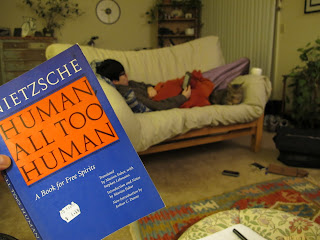
"Nietzsche was always defined through divided intentions. He did not want at any time to give up his critique of the human, all too human, as he continued all the while to build the great philosophical account of human nature that in less gifted hands would have been a treatise, an essay, an enquiry, a dissertation. He tried to practice philosophy in the way he thought of history as being practiced when in the service of life rather than in the production of academic scholars. His divided intentions very nearly queered his philosophical reputation, inasmuch as philosophers since his time have pretty largely just been academic philosophers, trained by codes of expressions Neitzsche fails to follow, whereas we might now see in him a model for how to do philosophy when we want to be taken seriously in the academy and at the same time effective in life" (xix).
And I've also been quite open about the fact that I do philosophy in a particular way because I find the true philosophical significance in its application to life, growth, and flourishing, rather than for a service within institutions. This is not an original position. In talking about Nietzsche's decision to leave the academy, Marion Faber explains, "It was not only his health, however, but also his conviction that academic life was stifling and a hindrance to a true philosopher which prompted his departure. As he had already written,...a philosopher must strive not merely to be a thinker, but primarily to be a human being; this latter goal would be better realized outside the confines of a scholarly existence" (xxii). And indeed, Nietzsche did not turn away from psychology but rather towards psychology for his explanation of things like gratitude and moral valuations. Furthermore, "We can at least speculate that such a psychology of gratitude may be partially attributed to Nietzsche's own conception of his life as struggle--with himself, his illness, and the outside world" (xxx).
So as I happily turn to the small stack of Nietzsche's books again, quite aware of the risky openness and vulnerability of my own personal feelings and the likelihood that they will be affected once more (and more!) by the pages that I read, I find a sense of comfort in the possibility that I am doing something right because I am open to and aware of this relationship between my life and philosophy. In Section 6 of Beyond Good and Evil, Nietzsche writes, "Gradually it has become clear to me what every great philosophy so far has been: namely, the personal confession of its author and a kind of involuntary and unconscious memoir; also that the moral (or immoral) intentions in every philosophy constituted the real germ of life from which the whole plant had grown. Indeed, if one would explain how the abstrusest metaphysical claims of a philosopher really came about, it is always well (and wise) to ask first: at what morality does all this (does he) aim?"
For me, I put emphasis on becoming healthier, stronger, new, and different from what I have already been, to live a life of happiness, gaiety, creativity, and vitality. All of this, is a practice in self-overcoming.
Here is the situation:
In my professional life, I'm currently reading a list of over 40 books this semester in preparation for my comprehensive exams. Fortunately for me, my tests will be on two fascinating subjects, Feminist Philosophy and 20th Century Continental Philosophy. I've tailored my lists to materials that speak directly to issues of affect, embodiment, corporeality, materiality, sexuality, neurobiology, psychology, ethics, and philosophy.
In my personal life, I've been traversing familiar yet seemingly new ground with respect to my relationships with others and with myself. My reading lists have been incredibly illuminating of my personal process to the point where I've had to quickly summarize for my therapist parts of Nietzsche's philosophy on health and vitality, ideas about the transmission of affect, notions of corporeal generosity, and Beauvoir's incredible classic, The Second Sex. I figure, she has to hear about what I am reading in order to understand from where I am coming. But more unusually, I also took time this week to explain to my advisor (the director of my committee) what sort of things I have been addressing in therapy. She knows what I am reading, but she doesn't know the extent of my involvement with these books and how they are affecting me day after day as I pass through the pages. So, in order for her to understand how I am reading Beauvoir and Nietzsche, commentary on embodiment and values, I told her about my own personal efforts in managing healthy boundaries with people, giving more of my space and my self to my partners, and working on integrating love, trust, vulnerability, and risk in my relationships with myself and others in ways that might finally help me kick this 10 month long cough.
I've spent hours over these weeks thinking about the profound and often unsettling connections that are occurring between my personal life and my philosophy. For instance, when I asked what sort of changes might occur if we follow Spinoza's and Nietzsche's idea of creating values out of a certain affective disposition (for example, joy rather than sadness), my advisor responded by saying something like,
"It's not something that we can really specifically imagine, but I do think it would change our relationships: with institutions, with others, and even with ourselves." She likened it to an example of the creation of gods. Imagine those who were so filled with gratitude, joy, and celebration that they created gods in order to have a place toward which these feelings could be directed. And compare that to a God that is created out of fear, threat, and insecurity.
This conversation occurred just a few days after I really acknowledged something important: I have high expectations. This is not news, for I have always known that I could not allow myself to be anything but responsible, mature, successful. I expect for myself to be able to take care of myself and to be independent. There are of course reasons for why I have been been made (i.e., created, sculpted) to be this way, but more importantly, it has led to a kind of inflexibility, irritability, and demanding level of expectation within myself that gets directed to those around me, and particularly toward my partners. This, too, is not news, for I have already been learning how to "lighten up" with others. In fact, it is easier to do that with others because I do it out of compassion, kindness, and love for others. But I hadn't yet paid attention to the root of the problem, which is that I could also "lighten up" on myself. Like the example of the creation of gods, imagine, I told myself, how even my closest relationships with others might be different if I could allow myself more room to be affected by others, to be less independent, to make stupid mistakes...(Of course, it would be naive at best to think that I have not already been completely affected by others, dependent on others, and made lots of silly, stupid mistakes. I get it on a cognitive level. I'm seeing what it means to internalize it on an emotional one.)
There have been numerous other experiences like this as I've been going through my philosophy, including the shocking dis-ease that occurred as I read the Second Sex and felt as though Beauvoir was narrating my life (which I have since heard is a common response), and these experiences are coupled by intense personal memories of old relationships, friendships, and family experiences. In particular, I've been appreciating the unconditional generosity of certain friends, family members, "adopted" family members, and mentors of mine over the years. As I hope to more fully grasp the fact that we are already constituted by an openness to the Other and practice that by means of concrete moments of pure generosity, I am grateful for the examples of this that I have already encountered. I have been remembering what it felt like to receive an unquestioned, unwavering, and unconditional love from one of the most influential people in my life during my most formative years...and appreciating the commitment and dedication that was expressed in that love. In a very simple sense, I am touching on what it means to love. And at the same time, I am reading carefully about Simone de Beauvoir's notion of genuine love and Merleau-Ponty's notions of intercorporeality, expressed through Rosalyn Diprose's writing on generosity: "The body at risk is a generous body, a body that is opened to the other. And this erotic generosity is creative in transforming the other's embodied situation, and hence existence, through a self-metamorphosis that...does not reduce the other to the self. Becoming flesh is a project directed toward and beyond the other, a giving without calculation that nevertheless gets something in return through the future possibilities it opens" (Corporeal Generosity, 86). More simply: "For Merleau-Ponty, this lending to and borrowing from the bodies of others is a generosity lying not just at the core of the erotic encounter but at the heart of existence itself" (89).
In spite of the often ineffable moments that reading book after book of this stuff can generate, I've had some brief conversations about my worries of being so personally involved in my work. Is there, or should there be, a strong separation between psychology and philosophy, that is, the personal work that I do in therapy and the philosophical work I do for comprehensive exams? Is there a danger in being too personally invested in the work that if others disapprove of the content or the method, I might be setting myself up for hardship when I go on the job market? Rather than writing this on a public blog for others to see, should I be pouring myself into journal publications? Is all of this stuff on relationships and personal growth just not philosophical enough for you, whoever you are?!? I've written about my struggles with these questions before. And I've recently gotten some feedback from others. My advisor said something like this (and I have always wholly agreed with this point): "If nothing else, it's good for life to approach it philosophically. And it's good for philosophy to keep it grounded in relevant issues that involve our lives." I say, what good is philosophy if it doesn't speak directly to our experiences? This semester has already been an unanticipated challenge and growing experience precisely because the books have been speaking directly to me!
And I am not alone. In fact, my favorite philosopher has stepped up to the front of the line of my next stack of books to read. Within the Introduction of Nietzsche's Human, All Too Human, Arthur Danto writes:

"Nietzsche was always defined through divided intentions. He did not want at any time to give up his critique of the human, all too human, as he continued all the while to build the great philosophical account of human nature that in less gifted hands would have been a treatise, an essay, an enquiry, a dissertation. He tried to practice philosophy in the way he thought of history as being practiced when in the service of life rather than in the production of academic scholars. His divided intentions very nearly queered his philosophical reputation, inasmuch as philosophers since his time have pretty largely just been academic philosophers, trained by codes of expressions Neitzsche fails to follow, whereas we might now see in him a model for how to do philosophy when we want to be taken seriously in the academy and at the same time effective in life" (xix).
And I've also been quite open about the fact that I do philosophy in a particular way because I find the true philosophical significance in its application to life, growth, and flourishing, rather than for a service within institutions. This is not an original position. In talking about Nietzsche's decision to leave the academy, Marion Faber explains, "It was not only his health, however, but also his conviction that academic life was stifling and a hindrance to a true philosopher which prompted his departure. As he had already written,...a philosopher must strive not merely to be a thinker, but primarily to be a human being; this latter goal would be better realized outside the confines of a scholarly existence" (xxii). And indeed, Nietzsche did not turn away from psychology but rather towards psychology for his explanation of things like gratitude and moral valuations. Furthermore, "We can at least speculate that such a psychology of gratitude may be partially attributed to Nietzsche's own conception of his life as struggle--with himself, his illness, and the outside world" (xxx).
So as I happily turn to the small stack of Nietzsche's books again, quite aware of the risky openness and vulnerability of my own personal feelings and the likelihood that they will be affected once more (and more!) by the pages that I read, I find a sense of comfort in the possibility that I am doing something right because I am open to and aware of this relationship between my life and philosophy. In Section 6 of Beyond Good and Evil, Nietzsche writes, "Gradually it has become clear to me what every great philosophy so far has been: namely, the personal confession of its author and a kind of involuntary and unconscious memoir; also that the moral (or immoral) intentions in every philosophy constituted the real germ of life from which the whole plant had grown. Indeed, if one would explain how the abstrusest metaphysical claims of a philosopher really came about, it is always well (and wise) to ask first: at what morality does all this (does he) aim?"
For me, I put emphasis on becoming healthier, stronger, new, and different from what I have already been, to live a life of happiness, gaiety, creativity, and vitality. All of this, is a practice in self-overcoming.
Saturday, December 4, 2010
Existential Themes and the Meaning of Life
I've now recorded the fifth video for my "Think for a Change" channel on Youtube. I think some of the earlier videos went more smoothly, but I appreciate my cat's presence in this one, even if he is distracting to me.
Subscribe to:
Posts (Atom)