Showing posts with label ladelle mcwhorter. Show all posts

Wednesday, September 14, 2011

Philosophers Can Be Fun(ny), Too!*

Tonight I finished reading Tina Fey's Bossypants, and yes, it's worth your time to read it. Especially if you are a woman. Especially if you have other work you should be doing. Especially if you are depressed. Especially if you have to eat some food tomorrow.  Because it's not only very funny, but also very inspiring.


Before I had even finished the book I wanted to write a post about the little insert on pages 84-85 entitled, "The Rules of Improvisation That Will Change Your Life and Reduce Belly Fat." I used to know these rules thanks to my brief stint with improv during high school when I was part of the theater freaks clique (yes, I used to call us that because theater people are weird, eclectic, and very often queer and those are all reasons for why they should be loved even more), but I was so happy to be reminded of them again because, as Tina notes, these are some good rules for life. They are:

1) Agree and Say "Yes", which means that you should respect what the other person has created and start with an open mind about where your scene will go.
2) Say "Yes, and...", which means that after agreeing you are to add something of your own. Don't be afraid to initiate and make your own contributions. They are worthwhile and will help keep things moving.
3) Make Statements, which means don't just ask questions about the scene, thereby putting extra pressure on the other person. Instead of simply raising questions and pointing out obstacles, be part of the solution.
4) There Are No Mistakes, only opportunities. Obviously, this means that what might be feared as a mistake could actually present the best opportunity for something really original, creative, and new. A happy accident. A new discovery, and something that could turn out to be really, really good.

If you stopped reading right now, I won't be hurt because if everyone lived by The Rules of Improv alone, the world would probably be a much better place. I envision a world with lots more collaboration and experimentation where statements that something is "random" or "awkward" would actually carry meaning again. (You should still buy the book though.)

If you are still reading because you are curious about what I finally decided to write upon finishing the book, well first, thank you for your perseverance. Second, I want to write about writing, philosophy, and how I wish I could be more funny like my friends. I'll start with the last one.

I have loads of funny friends. The handful of people from my high school theater clique with whom I am still in touch have, like me, gone to college and earned their degrees. Unlike me, they continued doing improv and sketch comedy over the past number of years, moved to big cities like Chicago and LA, and are really just a few laughs from the right people away from making it big time and living the dream. As a result of all that improvising, their levels of comedic timing and originality have undoubtedly exponentially eclipsed my own. (If you haven't heard of the Luke, Lee, and Matt Barats then I assure you that someday you will. And that someday is today, because now I expect for you to look up their respective stuff on YouTube.) Where they are acting and performing for live audiences multiple times a week, I have spent the years since high school graduation attending bigger and bigger universities while living in smaller and smaller towns, all the while reading dense (and mostly incredibly boring) philosophical texts from old men of centuries past. The only outlet for my humor is in poorly referenced jokes while teaching when I forget that my students are of the generation that was born in the early nineties, so they hardly know who Mel Gibson is or that "Willow" was actually a really scary movie. It makes me feel old and completely out of touch.
 
Over the years, while I have accumulated an ever-increasing library of books by dead people on things like death (so not funny...unless you pick any random page of Heidegger's Being and Time to read aloud and give a little chuckle at how utterly and ridiculously difficult it is to understand his writing (perhaps only philosophers will understand that reference, and perhaps that was actually Heidegger playing a joke on us that we're all just too dumb/take ourselves too seriously to get)), I have been fortunate enough to continue meeting more funny people. One of my friends is a super hip-artsy-cool lady who's rubbed elbows with the Groundlings peeps (think the cast of Bridesmaids if you are unfamiliar), who is now utilizing her openness for play in psychotherapy for kids. One of my other best friends' first response to the question, "What is the most important thing to you that you must share in common with your partner?" was that they needed to be able to play together, to act silly, to talk to one another in ridiculous voices. When I first met her, I walked into the living room of her one-bedroom apartment to find her making a fort while listening to The Sound of Music. Maybe that's not funny ha-ha, but it is fun-fun-fun-fun, especially for someone who at the time was twenty-four and a doctoral student.
She was also wearing this.
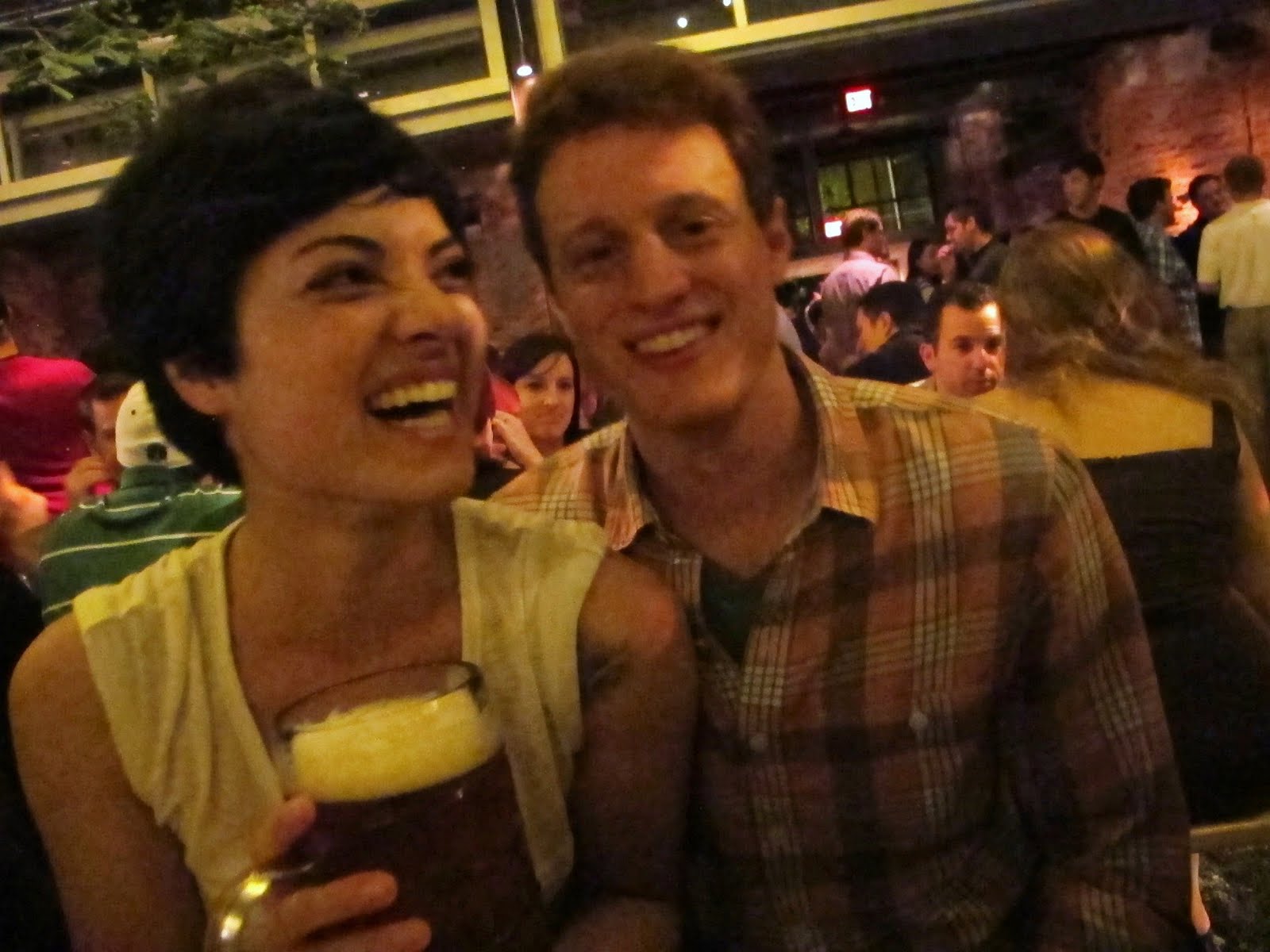
And finally, I tend to date really funny people. My boyfriend, who happens to also have some pretty hilarious friends, was singing Tenacious D's "F*** Her Gently" like a professional to a whole bar the night that we met. During our first real conversation with one another, we discovered that he was already familiar with some of my previously mentioned friends' videos on YouTube. I'm not surprised by this at all now given that he checks up on Collegehumor.com in the morning like it's the source for daily funny news, has introduced me to videos of  amazingly hilarious sketch comedy duos, would love to make a career out of doing his own sketch comedy if his band doesn't hit it big and he decides to not dig in people's mouths for money (I mean, he wants be a dentist, not that he doesn't know that picking pockets would be more lucrative), and he makes me laugh all of the time.

There are other funny people in my life, but I'll stop describing them here so that I don't make myself feel any worse about my decisions to become a perpetual academic nerd who hasn't had time to watch Billy Madison or Anchorman enough to laugh when my boyfriend quotes them or to know from experience that Modern Family is actually a really quality television show (I fake the latter when my grandmother talks to me about how great the show is, and when the former happens, I'm usually just met with countenances of subtle disappointment, mostly from myself to myself.) But before this turns into a pity party, let me quickly turn to the other two things I said I would talk about: writing and philosophy.

The short of what I am about to say in everything that follows is this: Perhaps it is the case that philosophy doesn't have to be boring and writing philosophy doesn't have to dry/tedious/painful/anxiety-producing, but perhaps reading philosophy, writing philosophy, and teaching philosophy can be fun....or even FUNNY.

Just because philosophy tends to be very "intellectual" doesn't mean that it's somehow above comedy--trust me, all of funny friends are as equally smart as they are hilarious. Nor is it the case that comedy can't address really important social and political issues--think of all the comedians who have been able to see the really effed up shiz in society and then make other people see it by getting them to first laugh at it (Two relevant examples most people recognize: Jon Stewart, whom I love, and his satirical counter-part, Stephen Colbert, whose early days on the Report proved how scary it is when Americans are unable to tell the difference between satire and right-wing neoconservativism. And don't forget my feminist, anti-racist, queer-mingling, even-less-bourgie-than-Fergie inspiration, Tina Fey. That's really why you should buy and read her book). Without saying that philosophy is not seriously valuable for personal and social change, perhaps there lacks an easily-identified or readily-produced overlap between philosophy and humor because philosophers often take themselves and what they do too seriously.

Fortunately, I can think of two exceptions, and they are not new names to appear on my blog. The first time I ever heard Charles Mills speak about his book, The Racial Contract (an extremely important book about very serious matters, mind you), he opened with a little routine about how, thanks to an epistemology of ignorance about the workings of global White Supremacy, one might be led to think that Africans, Native Americans, and everyone else in the world said, "Oh hello, White People! We are so happy to see you!" and then offered up their labor, their land, and everything else they had, like freedom and a quality of life, as a welcoming gift. Charles then noted how philosophy could perhaps be done a lot more like stand-up. I think that is a really good thought. If you've never been to a philosophy conference or heard someone give a philosophy talk (which actually means they just read aloud the paper they wrote in front of you for AN HOUR), then trust me on this. You would most definitely want it to be more like stand-up. I heard Charles give the same presentation about six months later. He opened with the same joke. It was still funny and his presentation was still a pleasure. And, truthfully, there are very few philosophy talks that I would actually enjoy sitting through a second time.  

The other funny philosopher who comes to mind is Ladelle McWhorter. Del is a philosophical role-model and inspiration to me in many, many ways (look around this blog and you will find her name everywhere), but one way that she inspires which I have not mentioned before is in how she writes her books. Like Charles, she's easy to listen to when she gives a paper, but like hardly anyone else, reading her writing is challenging, thought-provoking, inspiring, intensely philosophical, and really, really funny. Probably thanks to her Southern upbringing, Del can tell a great story. But it probably comes down to the simple combination of her terrific wit, honesty, and an unmatched willingness to speak in her own voice that makes Del's work so damn funny and fun to read. There are times when her sarcasm drips off of the page, and if one is diligent enough to check her footnotes, one quickly learns that footnotes can be so much more than places to put bibliographic references and self-indulgent digressions. They can turn reading philosophy into an activity that's more like a conversation with a really smart, but really weird friend. The kind of friend who throws strange tidbits of information in a story that aren't really necessary but that actually make the conversation way more interesting.

Charles and Del are two contemporary philosophers who make me laugh, and they are two who have been absolutely integral to my own ways of thinking about very important philosophical and political issues like racism and homophobia. And my man Nietzsche, well, he may have been really depressed and lonely, but he was also a syphilitic genius, and all of that together makes Ecce Homo a super entertaining read. Not just that, it's also the book where Nietzsche sheds the most clarifying light on what he was up to in all of his previous works. And one thing that is often mentioned about my other philosophical homeboy, Foucault, is that he would laugh in response to a lot of questions people would ask him about his work and what we should do. He read Nietzsche. I read them both. And I think there's a reason for my affinity towards them because, while I would never feel comfortable saying that I am the funniest person in the room, especially not when I'm with my friends and perhaps only if I'm the only one in the room, I would pretty comfortably guess that I might be the one who laughs the hardest, the loudest, and the most.
 

Why is that important?

Well, to show you how redundantly unoriginal I am (because I've already blogged about this a number of times before), Lynne Huffer writes, "As Nietzsche affirms, 'there seems to be nothing more worth taking seriously' than morality, a territory whose excavation will render the future rewards 'of a long, brave, industrious, and subterranean seriousness.' Among those rewards will be what Nietzsche names as cheerfulness. Such hope in cheerfulness is something Foucault and Nietzsche shared, as Deleuze reminds us in his description of Foucault's inimitable laughter. So perhaps the quintessentially Foucauldian cheerfulness of a self-shattering, life-affirming laughter will be the reward of a practice of thinking Nietzsche calls, in his own queer language, 'a gay science'" (Mad for Foucault, 186).

It's probably a consequence of being personally and philosophically influenced by the personalities and works of Charles Mills, Ladelle McWhorter, Nietzsche, and Foucault (not to mention all of my hysterical, non-philosopher friends), that I feel strangely comfortable with what some people have noted as my very "casual" style--which perhaps is a more polite way of noting that I have insisted on doing things (teaching/writing/philosophy in general) how I want to do them simply because I want to do them that way, regardless of how other people say one should do it. (There are other ways that people have described this attitude; put in terms of non-verbal communication, I think it involves thumbs or at least one finger.) Really, though, it's simply that I try to not take myself and academic philosophy too seriously, which again, doesn't mean that I don't think that academic philosophy can't do very important and meaningful work. I just mean that I think it's okay to have fun and enjoy it, too, and it may even be that doing so makes our philosophy better.


When I teach, I often....I mean, on a daily basis, I say really outrageous things to my students. In class, they laugh, I laugh, we laugh, and quite a lot actually (no, not all of my jokes are about Willow, and yes, sometimes I can craft a pretty witty little quip). I think that my approach to philosophy and my personal style helps make class fun, exciting, and engaging. I enjoy teaching, and I think that my students often enjoy learning about and doing philosophy with me. So I may not be doing improv in Chicago with the best of them, and I will probably never get to realize my childhood dream of being on Saturday Night Live, but that doesn't mean that I don't also have plenty of opportunities all of the time to practice being a funnier person. My students might not appreciate being the guinea pigs of my slow comedic development, but somebody else down the road might really appreciate that he or she didn't have to be the one to grimace and shake her or his head at all of my bad jokes. Sorry, reader, you're still a part of the grimace and shake-head audience of the  present. 

I know, I still haven't gotten to the bit on my own writing yet.

If it isn't obvious by now, and I think it really ought to be, I am seriously considering the possibilities for how to write philosophy in a way that mimics how I teach philosophy. I've noted before that I can write on this blog in one sitting for hours on end without hitting the walls of my writer's block, and that maybe I could just write my dissertation in pieces on here (kind of like what started to happen with this post). But I was probably putting too much emphasis on the formatting differences between the encouraginly small-ish text box that I see when posting here on my blog and the blank Word document that spans the monitor screen when I sit to write my "real" work. Maybe it's less a matter of what medium invites my writing and more a matter of how I write at all.

When I teach my class, I'm totally myself. I'm a whole person and I let my students see that. I'm honest, I make mistakes, and actually, my best classes are often when I don't prepare lectures but instead improvise to facilitate discussions after my students give their presentations. When I write, though, I often feel restricted by what is "appropriate" in terms of structure, voice, style, and language. I usually feel disconnected from my academic papers when I go back and read them again months later. They hardly ever sound like me (and yeah, I even think that they can be pretty boring).

So here I sit, having read Tina Fey tonight and not enough on theories of affect, having written almost 3,000 words in one sitting and hardly any at all in the past week and a half on my (still not enough to even be called a sufficient rough draft of a) dissertation prospectus, but also feeling really inspired and excited about philosophy. What's a girl like me to do, huh?


*In case you didn't know, the use of parenthesis to create a play on words and meanings in the title or body of a philosophical piece is now commonly employed and widely considered a mark of one's complexity of thought, of one's affiliation with the traditions of post-structuralism or feminist theory, or simply as evidence of one's desperate desire to prove that she can be clever, too, just as clever as her non-philosopher friends.

Wednesday, April 6, 2011

The End of the World: Undertaking Whatever is Hardest

This reflection was written in response to a paper by Ladelle McWhorter, which she presented at Penn State last week for a conference that honored the work of Charles Scott.

Reflecting on Charles Scott’s role as one of her most influential teachers, Ladelle McWhorter focused her paper, “Whatever is Hardest,” on the ethical question of teaching. Looking back on her own experiences in Scott’s classes, McWhorter described Scott’s practice of philosophy as one that enacts an experience and creates a philosophical event. It is a practice that opens up possibilities for seeing, feeling, and thinking. While describing her experiences of sitting through his lectures, McWhorter reflected that “something philosophical had happened to me.” This, she explains, is because Scott’s practice of philosophy is a kind of undertaking that requires a willingness to turn toward that which we do not know and what we fear that we will never understand. It is a willingness to turn toward and stand with the excess, with whatever is hardest.

Teaching undergraduate students is hard. It may even be one of the hardest things to do because, as McWhorter noted, one of the central goals of teaching is to make students aware of their intellectual and ethical freedom, that is, to make thinking in general and thinking on particular questions possible again. Nearly any teacher can attest to just how challenging it can be to get students thinking, and thinking freely. To make things even harder still, McWhorter discussed her recent experiences of teaching environmental ethics to her students. The difficulty of this task does not stem from the controversy of intrinsic value or anthropocentrism, but rather from the fact that if one pays attention to the consequences of human production and consumption and the state of our planet’s water, ground, and atmosphere, one has to face the gravity of our environmental crisis. The thousands of poisonous toxins in our ecosystems and bodies, the increase in cancer rates, sea-level rise, thawing permafrost, gigatons of carbon dioxide being released into the atmosphere, and the utter necessity of petroleum to power anything and everything in our current lifestyles, all of this leads to what was frequently referred to as “impending catastrophes of epic proportions.” Acknowledging these statistics and likelihoods while taking on the responsibility to teach young minds and answer their questions of “What do we do?” in the face of Armageddon, doomsday, the end of life as we know it—this is hard, perhaps one of the hardest things to do.

Before I continue on with the rest of McWhorter’s paper, it is worth noting what was coming up for me as I listened. While sitting through her descriptions of the very sad and scary state of affairs in which we live, it was hard not to feel at least a little bit overwhelmed, if not completely panicked. Thanks to her diligent research, McWhorter was able to paint a detailed picture with facts and numbers (often too large in size and effect to really comprehend) that illustrated the interrelated risks which threaten our lives and the planet. It must have been about forty-five minutes of relentless evidence explaining how we are hopelessly doomed because even if we deal with poison in the water, we still have to worry about rising temperatures, and so on... The magnitude of our problems, the level of crisis facing our planet, is so large and so great that describing these “impending catastrophes of epic proportions” as “the end of the world” would be no exaggeration. I can imagine how the sheer act of sitting through her paper could easily have been enough to put some people over the edge.

But as I started to shift around in my seat and feel my palms sweat, exchanging nervous glances with those next to me, I couldn’t help but notice that it was really hard to sit through McWhorter’s paper. It was hard because her descriptions put us face to face with the most difficult realities, the most terrifying statistics, and the most uncertain of futures. Much like her descriptions of Scott’s lectures, McWhorter’s paper gave me the distinct sense that “something philosophical” was happening to us. And as if this one-hour paper paralleled the experiences of her class on environmental ethics, I found myself echoing her students and wanting to ask, “What do we do? What can we do? What should we do?” When McWhorter described her answers to her students, it seemed that now they were also appropriately directed to us, those in the audience who evidenced a willingness to turn toward these difficult realities and a future full of frightful uncertainties. She said, “I don’t know.”

It was at this point when McWhorter returned to the ethical question of teaching. When the future of the world is not going to be the same for her students as it was for previous generations, different even from their parents’ and professors’ generations, what might teaching be at this juncture? McWhorter even wonders if it is wrong to lead her students in the environmental ethics class to the end of this road, where they stand together and look out onto a future without being able to see how it looks, perhaps if it is even there.

These questions are interesting for me because as McWhorter described a type of “border” relationship that separates her from her undergraduate students—they belong to the future in a different way than she does—I immediately recognized myself as living on the border. I am part of this generation that is growing up in the face of what is yet to come, but I also have my own students to whom I feel responsible to equip for the future. With the double weight of student and teacher on my shoulders, I listened closely to what McWhorter said next.

McWhorter offered her students (and me, and perhaps even my students through me) this much: You will have to live and face the unimaginable. We can’t prepare you for the challenges and problems that you will have to meet and try to overcome. Don’t let your parents and your teachers dictate your choices. In short, you’re free.

With a moment to let the words sink in, I felt something. Better? Not really. But I did feel something. Something philosophical? There was a moment, I guess, and in that moment I had the increased sense that teaching at the turn of the 21st century is an especially unique task. But there was something more. I know that I am not only teaching, but I am also a student. I am also learning. And the freedom involved in teaching and learning in this moment is a freedom of release, of openness, of possibility. It’s not just a freedom to vote or a power to choose to live green, but a different kind of freedom, grounded in contingency, and with that, not-knowing.

I can’t help but agree that one of the most important goals of teaching is to make students aware of their intellectual and ethical freedom, to make thinking possible again. This was one of the most significant reminders that I gained from listening to McWhorter’s paper, in part because it reminded me that my own thinking is also free. But I can’t forget that the paper was written and presented to honor the work of her own teacher, Charles Scott, especially in celebration of his practice of philosophy, a practice that pursues whatever is hardest. So maybe, after all of this, I actually was feeling a bit better. I was feeling better because for that hour I was put back in a place of acknowledging that I am also a part of a "lineage" of sorts of people who seek to embrace how studying and teaching philosophy as a transformative practice can open up new ways of seeing, thinking, and feeling. Approached in this way, philosophy is already an ethical undertaking. And there is something important contained within that attitude and approach. Part of me was relieved to know that I am shaped by and following in the footsteps of others, that despite the hugeness of it all, there is a way to move in the world. So, in addition to freedom and a bit of philosophical company, one might also find there a small sense of hope.

Thursday, January 13, 2011

Products of our "Culture"

Some thoughts from today:

1). You can learn a lot from your relationships with people.

We often hear things like, "You can't be in a relationship with another unless you can first be in a relationship with yourself," and "You need to learn to be single (and okay with it) before you can be a good partner for someone else"... While those may be really good things to do--to learn how to fulfill your own needs, to know that you don't need to be in a relationship with a significant other to be happy, to spend time getting to know yourself, your needs, your wants--I have learned that there are also some things that you can only learn from being with others. Maybe "others" in general, but I am particularly thinking about being in a romantic, emotional, personal, deep relationship with someone who knows you intimately, perhaps better than you know yourself.

Over the past year, I really have learned a great deal about myself, but the majority of my learning was about things that I could not have shown to myself, no matter how hard I may have tried. Perhaps there were things that I knew I wanted to work on, in theory, but I couldn't have put them into practice alone. Despite however self-aware I was and am, there are some challenges that I could not present for myself. Like what it means to really trust someone. To really respect someone enough to really, genuinely listen to them. To acknowledge when I don't know something, and not just because I haven't ever thought about it before, but because I truly do not know. And perhaps I couldn't because our experiences are so different.

And I learned that there are possible ways to address these differences that don't include reaching an agreement, determining which way is best, or forcing an opinion for the sake of taking a stand. I learned what it means to accept another person. To step up to seriously uncomfortable, counter-intuitive situations without saying anything or doing what has over my lifetime become a habit, a "knowledge" in my body that moves me. To accept that there are lots of things that are different from how I might handle things, how I might engage with others, how I might hold myself and act in the world, and that this is okay.

2). Cultural Differences are REAL

Much of my learning has arisen out my bi-cultural relationship. Over the past year, I have come to a deeper appreciation of just how "Western" I am and how very different an Asian culture in, let's say, Taiwan directs people's lives. Maybe you could get this "cultural sensitivity" from traveling or spending lengths of time abroad, but let me tell you, a way to feel like you've hit a brick wall with your face is to confront these differences in a relationship with a significant other. The most well-intentioned things, which always come from a place of love, can come off as very rude, insensitive, inappropriate, or extremely frustrating. One can come off as too dumb, too strong, too arrogant, too timid, too shy, too polite, too week, too impatient, or too patient....almost too anything. And that is very hard to deal with if you haven't been able to actually realize exactly what it is that you do that comes off that way.

I don't want to use "cultural differences" as a cop-out, but it is often a very frequent source of our misunderstandings, which can often lead to conflict. And what I have realized is that some of my most personal values and convictions are not really my own simply because I am a strong, reflective, confident woman. Much of what I do comes from my culture. Even though I read and talk a lot about social constructivism and cultures influence on our subjectivity, quite often all of this remains pretty abstract. Importantly, then, I think I have started to realize that I didn't/don't really know what is meant by "American culture."

If asked to provide a cursory list, I probably would have identified western, American culture with mostly very bad views that have supported very bad things in history. Slavery, colonialism, racism, exploitation, elitism, mass consumerism and so many other evils were products of an emphasis on strict liberal individualism, capitalism, "picking oneself up by one's boot-straps" without acknowledging who made your boots, assumed "rights" to the pursuit of one's happiness (even at the cost of other beings and the environment), etc. But that's because I'm sooooooooooo radical.

What I didn't fully appreciate about myself is that the way I communicate, which I often think reflects my personal emphasis on authenticity, my genuine desire to be always honest with others, my commitment to personal integrity and continued development, and my deep hope for real, meaningful human connection with others are also "cultural" things. Maybe not all Americans talk the way I talk, are not as blunt, direct, and transparent as me, and maybe not all Americans value these things so much that they live each day by always striving to approach their students and friends and family members with the same level of respect and honesty (by presenting my most authentic self). But all of this assumes to reflect a certain kind of "respect," a particular sort of "honesty," and is rooted in a non-universalizable conception of "self."

Oh, I could go on and on about the many bumps and hiccups that I have encountered this year and the many hours of tangled conversation I have participated in to try to find a common ground or mutual understanding or satisfactory approach about what to do next, and I could list out the things that I find irritating, irrational, unhealthy, counter-productive about "other ways to do things"...but I won't.

Because what I have tried to do is think about my situation and these issues more gracefully.

In philosophy, and especially feminist philosophy or social philosophy or any liberatory philosophy that takes social equality and justice as an end, this problem is captured by a question that often comes up, "How are we to work together to reach a satisfactory state of affairs if we are trying to addressing the varied, multiple, and diverse needs of very different kinds of people if their/our experiences are so disparate that we can't understand one another or our respective situations?" One response, which is my favorite so far, has been offered most eloquently by one of my favorite philosophers, Ladelle McWhorter. She explains that “if we discipline ourselves to the pleasures and powers of connections that occur alongside of but differ from the pleasures of knowledgeableness, of identities and stalwart commitments, if we stray far enough afield of our carefully classified selves, something unforeseeable, something new—something that might be called free—may very well occur” ("The Revenge of the Gay Nihilist", 2001, 125).

3). By not knowing everything, I learn a lot.

I have realized that my only recourse (thus far..) is to create a space for our differences without trying to mitigate them. And in doing so, I actually give myself more space to also grow beyond what I have been constituted as by my culture.

Instead of apple pie, our patriotic favorite, I think American's need to eat more Humble Pie. And put ourselves in situations where we can better learn WHY.


P.S. Thanks go out to Del for being my go-to rock star, favorite contemporary philosopher. Thanks, too, to my friends for their conversations today. And many thanks to my girlfriend. None of the seemingly mundane things in life would be as painfully complicated and frustrating, I mean, would be nearly as growthful of learning opportunities without your sagely wisdom. And patience... ;)

Tuesday, December 14, 2010

I may not be a Doctor, but...

Some people get really pissed at universities that use and abuse their graduate students and force them to teach all the mundane low-level classes to undergrads who, often with a strong sense of entitlement, don't care about class, don't try, and certainly don't appreciate you or the fact that you have your own work to be doing as you go through the motions before they get their easy "A."

As a graduate student in the third year of my program, I have already taught about 150 students of my own in four classes (not to mention the 60 or so others I TAed for in a class that even I struggled to really appreciate). But for me, I view teaching as an opportunity and I am so happy to have had experiences in the classroom that have helped my learning, thinking, and growing more than almost any class I have had as a graduate student. That I get to teach is one of the only reasons why I have made it this far in my program (and by constantly reminding myself that my life was literally changed after taking one philosophy class from one of the best professors, so I know that it is at least possible to make a difference, even if my students don't become "philosophers" themselves).

Fortunately, I have had the opportunity to put together my own syllabi for classes that I have been genuinely interested in teaching. In "Basic Problems of Philosophy" I focused the course on four questions: What is philosophy? What is the purpose of philosophy? Who is the philosopher? What is the philosopher's task? I loved the 6-week intensity of teaching "Philosophy, Love, and Sex" this summer. Seeing my students every day was very conducive to the continuity in conversations that I think is essential to deep thinking. And finally, I have just concluded my course "Philosophy, Race, and Diversity." We started with one of my favorite essays by George Yancy on philosophers as "trouble makers" and read some excellent books--Charles Mills' 'The Racial Contract,' Linda Alcoff's 'Visible Identities,' and Ladelle McWhorter's 'Racism and Sexual Oppression in Anglo-America" (go here for a recent interview about the book). This class was by far the most challenging of them all. At times, I was fearful that the class would end up a complete failure, worst of all, because my students were so often reflecting RACIST views, not anti-racist views (obviously, the latter are my preferred perspectives).

My goal in teaching is always to help my students cultivate the skills that will allow them to be more critical thinkers, not just about society and problems around them, but to understand themselves better, too. Just like any other kind of interaction, if students put their defenses up or are unwilling to be honest with themselves and others, we don't get very far (sometimes, as I have just learned, it takes a whole semester for people to put their guard down...like life, I suppose, some people don't ever get there in your time with them). Listening to others is crucial, being able to write and speak in ways that express your views is important, and the ability to be self-reflexive is completely necessary. And I don't teach material just so they will know what so-and-so said about "x." My methodology and selected content are intended to provide students with insights, perspectives, and questions that will enable them to be better students, better citizens, and better people (I am hugely influenced by hooks here). Pardon the redundancy, but I don't want to just open them up to philosophical lesson. Ideally, I hope that by being more philosophical, my students will also uncover some life lessons that will help them as they move through the world (it's philifesophy). Clearly, I have high hopes for my students and high expectations of myself!

Given the challenges of teaching, the highs and lows, the adrenaline rushes and great disappointments, the moments of insight and spells of insecurity, and the open-endedness of it all, which can often be devalued as just the cover of ineffectuality, I have to keep some record of the rewards. I don't want to let myself get carried away in worries that this is worthless work or catch a spell of the contagious skepticism that is always circulating among philosophers (and academics) about what we do.

At the end of each semester, it's always a bit scary to wait and see if any of the students "got it" (and not just if they adequately comprehended the arguments. I mean the point of this whole learning thing in general). Fortunately, after this go around, my students papers demonstrated that many of them did end up "getting it"--which is HUGE given that we had to bust through some seriously thick commitments to epistemologies of ignorance (Mills, 18). I am re-energized by the notes and emails that my students give me. Because this semester was especially challenging, I write some of the final reflections from students below:

"...I discovered a feeling that I had not had at the conclusion of other books. It's not that I had it all figured out, but I did finally see the big picture. Instead of just trying to fix racial differences overnight, McWhorter stressed that we keep challenging what is normal and abnormal, as my classmate Ray pointed out. She wants us to keep "doing likewise"...While she--and I--knows that it is not a guaranteed that we can get [to a world without racism], for now this is all that we can do. At the beginning of our class, I was one of those people that thought philosophy really was about old white men and their ridiculous ideas. Now, I am one of those "trouble makers" myself, and I am damn proud of it."

In a later email, this student also wrote,

"Cori-

I just wanted to thank you for this semester. I truly enjoyed every class that we had, and always looked forward to Tuesdays and Thursdays because of our discussions. This is a class much different than my others, not only because it was an elective, but also because I will be able to take so much from what we've talked about all semester. I really enjoyed our conversations, which led me to discover a few things about myself. I wish that all of my classes were like this one and hopefully we can meet up again in the future."
____________________________________________________________

"The semester before I had just taken Sociology 119 which had dealt with race, so I thought the course would be easy and that I would already know everything. I was very wrong. One can never know too much about racism, there's always something to talk about and learn about. This is one of the things I have recently learned. I learned many things about racism including what the word actually means, how identities are formed and interpreted, and how many people think of racism itself. Along with what I have learned about the subjects taught to me the past semester, I have learned about myself.

...

I spoke in a way that reflected my confidence of me not being racist, and that I knew everything about racism. Outside of class I talked in a way that I was not racist and in a way that I knew all about the subject matter. Whenever I had a conversation about someone being racist I put them under the bus and defended my actions. This is much like 20th Century American and what they did to Hitler. After reading Mill's (sic) book I had still not realized all the things I did and the way that I am still racist. Ironically I was a perfect example of Mill's main point; I was part of the epistemology of ignorance. It is a term that I had never heard of before reading his book, but it is a term that I will use many times after. It 's a very ingenious term which describes the 'White' person's ignorance to racism. I think the reason why at first I did not realize that I fell into his theory is because I had defined racism in a narrow way. I defined racism in a way that made me not racist.

...

I have enjoyed this class and am happy that it has allowed me to look in a mirror. It has allowed me to think in a different way, in a way that will make me a better person. Earlier I used the phrase that I was wrong with my thoughts, but I think that was a little inaccurate. (The sensitivity he demonstrates here blows me away!!-CW)I did not use those phrases to say that I am right now. That would allow me to quickly slip back into the epistemology of ignorance. I will never be right, there will always be something to learn or to adjust in my thought process. From this course forward, I will continue to learn, and I will do my best to make myself a better person especially when it comes to my ideas on racism."
____________________________________________________________________

"After learning the genealogical account of our history along with ideas fostered by you, Cori, I feel today compared to the first day of class, that there is now something that I can do to help get rid of racism and racism against the abnormal.

Overall, this class really did broaden my horizons on things that actually happened in history to what the common beliefs are about such events...I did not realize it until the end, but I thought McWhorter's book did a great joby to get us see that some of our values are flawed and that being more critical is necessary. Well, there you have it, these were many of the things I learned and that changed how I think and view society now. I was glad to have participated in a class that generated this much thinking, and really do feel my horizons have expanded from taking this class. Thanks, Cori, and hope to still see you around campus."
____________________________________________________________________

Though shout-outs of appreciation warm my heart, the truly rewarding moments are when I see my students becoming better writers and better thinkers, and especially when they start making connections on their own!

I am immensely grateful for the work of those thinkers who write amazing books who give my students and me lots to chew on. I am also grateful for what I learn from my students and what I learn from undergoing the process of thinking through big questions and important issues with them. They help me grow, and they also motivate me to keep doing what I am doing because they prove to me that teachers DO important work, regardless of whether or not this happens in a classroom.

Teaching is a skill and an art form that I hope to continue cultivating in myself. It's been my dream, my goal, and what I have wanted to do for a very long time. And I must admit, that I am quite pleased that at the ripe old age of 24, I have already had been able to do what I want to do, how I want to do it. Whatever happens after I actually get my degrees, I will be satisfied with what I have been able to accomplish as a graduate student. And I will, like some of my students, always try to keep in mind the lessons that I have learned and use them to help me be a better teacher, a better student, a better philosopher, and a better person.

Monday, November 8, 2010

big thoughts, big feelings

I just returned from the annual SPEP conference. This year it was held in Montreal, Canada.


I decided months ago that I was going to attend even though it's late in the year and stress levels are building as the semester edges toward the end. It was my third time going now, and I was honestly quite nervous about making the trip. Not just because it involved driving in the car for 10 hours there and back, and not just because there are lots of philosophers around (and often it is encouraged that you meet them, seem impressive, and get on their good side). I think I was nervous because every year so far the SPEP trip has involved some very big feelings: for the first two SPEPs I was in the midst of two long, difficult breakups. And last year, loneliness, sadness, and pain were coupled with some of the most excited, giddy feelings that I've ever felt (to the point of acting stupid and silly). Feeling all of this while also being displaced in new cities and trying to find good food is quite the mix. Oh, and then there is the philosophy part of it all.

I explain to people that my favorite part of SPEP is going to sessions to hear about the sort of work that I find most interesting and to see philosophy be done in the way that I think it should be--in collaboration with others who share and discuss their ideas in productive, supportive, and rigorous ways. To that end, I am selective about my session choices. I've come to learn that the kind of people involved in these sorts of things are often more important than the ideas. Similar to how a class description can sound awesome, but the overall experience completely hinges on the person teaching it, SPEP features a decent amount of talks on feminism, sexuality, gender, race, etc., but that doesn't mean it's all good. All of these philosophers, who for such a long time were just names to me, are really just people. Some names I have looked up to as a student in philosophy. Some names were those that inspired me and made me want to do philosophy. But out of these philosopher-people, some are nice, some are awkward, and some are not worth making a trip to Canada to be around. Fortunately, I know some really nice people, and I was able to spend some time with them.

I had dinner with Ladelle McWhorter on my first night there. We spoke for nearly two hours about everything and nothing that I had really anticipated. Philosophy, projects, life, ideas, how things were going. We were supposed to talk about my reading lists for my comp exams and my idea for a dissertation project, but we only managed to sneak that in before I had to run off and make sure that I didn't have a parking ticket in my windshield.

 I told her about my youtube channel and her place in the first video on role models. She didn't think it was creepy. Instead, she thought it was a cool project. I'm glad she approves.

We talked about affect, and the transmission of affect, and the sort of people who transmit a lot of affect. She said I am an affective person, and I told her that I now know that means I can affect people positively and negatively. Then we talked about the size of people's bubbles, the size of towns, and the ontological experience of affecting and being affected by others.(She also assured me that graduate school and small towns make people crazy, so I should expect to be kind of crazy for the next few years.)

The panel on Del's book, "Racism and Sexual Oppression"
 We also managed to talk quite a bit about ways to deal with feelings, especially negative feelings that people don't want to have (like homophobia or racism) and what sort of practices people can undertake in order to be and feel differently than they do. With reference to her most recent genealogy, she mentioned that it wasn't just the research and the writing that changed her, but that there seemed to be new opportunities opening up to her. She recognized them as opportunities, perhaps because she was more attuned to them now, and then she got to know new people. There is a very important hermeneutic connection between how we prime ourselves to see and think and be and feel new things. It's not a metaphysical secret or special power or anything, just something very simple about how we orient ourselves in the world and to what we remain open. It was lovely to talk with her. And it was definitely a highlight of the trip.

I went to a paper by my advisor, Shannon Sullivan. I wanted to see how she handled the responses to her work since I expected it to be rowdy. Just as I hoped, she responded with clarity, coolness, and with a very obviously genuine air of wanting to learn and hear from the audience members' comments, despite the fact that some people in the audience responded with overt sarcasm, an inability to listen, and immature hyperbole.  I have good role models.

And I had a meeting with another new mentor, Sharon Meagher, about Public Philosophy. I am currently working with her to set up the Public Philosophy Network. She's committed, dedicated, passionate, and competent. I appreciate seeing her influence and witnessing the involvement from other philosophers who are interested in transforming the discipline of philosophy.

Another highlight of the trip was seeing my friend, Ami. She is one of the loveliest individuals I have ever met. I only wish that we could see each other for more than one dinner, one night, once a year.


Look at us two years ago with Del; PIKSI 2009
But I ended up with some very weird anxieties, too. The philosophy world is so small! The same people go to these conferences year after year, and they are the ones who write the books, edit the journals, teach the classes...so if you are great, everyone knows you. If you do something stupid, everyone can know what you did. And if people love you or hate you, they often have the capacity to devolve to high school mentalities. I hope this is only my perception as a grad student who has only been three times now, but I am fearful that there are the popular kids, the weird kids, the loner kids who circle the perimeter of the receptions, and the bullies. I am worried that this is going to be my (very small) world and I will be a part of it. Given my talk with Del and our discussion on being crazy, bubbles are bumping up against bubbles here in a serious way.

And another thing: SPEP is one of the only things that I have really experienced that I can safely bet will be a part of my life for the rest of my time in philosophy. Every year I will go and I will see the same people; slowly I will become one of the old philosophers and new graduate students will be attending. They, like me now, will be poor, sleeping on the hallway floor in someone's apartment in town after driving across the border because they can't afford plane tickets or rooms in the conference hotel. Even though I love philosophy and there are good people, the thought of growing old at SPEP year after year weirded me out. I can't imagine having  kids or even having a house with as much surety about how its going to be since I haven't yet had a kid or owned a house. But now I have been to three SPEP conferences. And it will probably be much like that, year after year. Until I quit or I die. And that is strange.