This is a presentation I did in August at the first Liberal Arts Scholarship and Technology Summit at Penn State University. I reflect on the work that I have been doing on YouTube and this blog. You can see the video I did just before this presentation on "Complex Human Interactions" here. (I'm reposting it now mostly for archiving purposes.)
Video streaming by Ustream
Showing posts with label graduate students. Show all posts
Showing posts with label graduate students. Show all posts
Thursday, September 22, 2011


Wednesday, July 20, 2011
"Oh, Philosophy. So what do you want to do with that?"
"Do you want to teach?"
Yes.
In fact, before I even knew what philosophy was I wanted to teach, at least in some capacity. I didn't know what I wanted to teach, but I knew that I have always felt comfortable in the role of an educator, leader, and mentor.
"So do you want to become a professor?"
Well, I don't know.
I only ended up here--in academia, in graduate school pursuing a dual PhD in Philosophy and Women's Studies--thanks to a unexpected and, yes, lucky turn of events. The tale of my path includes the moment when I decided to not drop out of college after my second year and then when I declared a major in philosophy, not because I loved it so much, but because it was pretty much the only thing I could do and still graduate in four years. There was one justifiable benefit of becoming a philosophy major though. As one of my not-so-warm-and-fuzzy professors at the time told me, at least it would teach me how to read, write, and think, which are helpful skills no matter what you end up doing. So, I stayed in school and studied philosophy.
I could not have anticipated how my life would change so quickly after that.
In the fall of my junior year I took an amazing, mind-opening, totally inspiring class with a brilliant and enthusiastic young professor who has since retained his position as easily one of the most influential people in my life (Shout out goes to David Deane!). And with that class, as I heard about new ideas that I had never even considered before and was introduced to concepts that seemed already familiar because they made sense of my experience but that I couldn't have articulated on my own, I knew that something big was happening.
I felt the metaphorical path beneath my feet twisting in new directions, leading me, a naive, but excited twenty-year-old, to board planes to Syracuse, NY on my own and attend a conference for no other reason than to just go and listen to some of the people whose work I had started to read, such as Judith Butler and Helene Cixous. Being that this was my first conference and I was so new to everything in the world of philosophy, I didn't really care enough to heed the advice of my professor to make connections and make myself known (to people who, for example, are now vice-presidents of the American Philosophical Association..and my facebook friends! Ha!). Motivations for networking were out of the question, but I was so moved by Cixous's keynote paper, "Promised Belief," and again, so unaware of professional etiquette, that I did follow her around and pester her until I was able to tell her about the amazing experience I had during her reading of her paper and ask about feminine writing. The funny thing was that I was actually disappointed when she responded to my question. She stated, "I am a philosophical poet. Derrida is poetic philosopher. But I never intend to "demonstrate" anything with my writing. I just write to write." At the time, I didn't really even know who Derrida was, let alone appreciate how awesome it was that she followed this deflating comment by saying, "That is not my project. But it could be yours!" Despite how incredible it is to me now that one of the most significant figures in feminist theorizing and writing passed a torch on to me (a torch that I guess was never really her's but perhaps was already my own), at the time I was more intimidated by my young professor's comment during one of our coffee-fueled conversations when he said, "Of course you will go on to graduate school, and you will write a book, and you will become a professor. And you will be superb." A BOOK?!? Now that was unfathomable.
But he was right and my path was obviously heading in that direction. I got more involved in philosophy, went to a week-long summer nerd camp for aspiring young philosophers at Penn State before my senior year, returned with even more passion and energy for doing philosophy in new ways, and when I returned to Colorado, I used that newly found perspective and confidence to become more outspoken in the many philosophy classes and graduate seminars that I took during my senior year to complete my bachelor's degree. And in the course of those two years between nearly dropping out and being admitted to graduate school, I totally fell in love with philosophy. More importantly, though, I developed my own voice.
The unpleasant truth about graduate school, though, is that no matter how much you love what you do--the research, the learning, the intellectual stimulation--and no matter how passionately your pursue it for noble causes like greater justice, equality, and positive social changes, it doesn't take long for doubt and disillusion to set in. Even (or perhaps especially) those who are most passionately motivated for all the right reasons come to the conclusion that academia is just not for them, that they can't actually bring about the changes that are most important to them, that theory and practice don't really intersect in sufficient ways. So people burn out. And a lot of people leave. And at some point, many of those who remain do so only because they've already gotten so deep and dedicated so much time that there don't really seem to be any other viable options.
For the first two years of my graduate career I was constantly tempted by the thought of quitting, especially when the end of the semester rolled in and paper-writing season consumed every hope for sanity and a healthy, balanced life. I would have emotional break downs and cry. I would be in physical pain from typing for so long and cry. I would think about a lifetime ahead of me of doing this all the time for my career--reading things that other people wrote that nobody else ever read or cared about except for a few people like me, who were trapped in the depths of hell forcing themselves to write papers that nobody else would ever read or care about. And then I would sometimes cry some more. Much like when other people find themselves in an unhappy marriage and have a mid-life crisis, for graduate students it is during those times when papers have to be produced and turned in that everything else seems to lose its meaning and you really question your life choices. However, even when my now best friend (whom I met when we both started the philosophy PhD program together) left before Thanksgiving break of our first semester, I decided to wait it out at least a year before making any drastic decisions.
With time my perspective shifted, but only a little. During my second year, most of the graduate students I knew in my own program and in other disciplines had gotten quite comfortably blunt about their dissatisfaction of being in graduate school. My own discomfort manifested itself in explicit questions that I directed to my advisors, professors, academic superiors, and even "philosophical role models." I asked many of them, "Do you have any regrets?," meaning, would they have gone a different route in life if they could do it over again? Some actually had the nerve to forsake any kind of consolation for why I would ask such a question and said yes. Others gave a very qualified no. Only one person could say, "Absolutely not. I love what I do." (This person was Ladelle McWhorter, another of the most influential philosophers in my life, and definitely one of the handful of people who have encouraged me in ways that have actually kept me in philosophy. I am hugely grateful for her, and my style and approach to philosophy are significantly indebted to her example.)
Despite the lack of overly-encouraging hindsight from my superiors, it was at the end of my second year when I was finally able to come to my own decision about whether or not I would stay in graduate school and finish my doctorate degree. And the decision was made because during my fourth semester I was able to teach my very own classes for the first time. I was able to craft one syllabus on my very own, and I taught it to two classes, about 65 students. And I loved it. It wasn't easy, especially since I was taking four graduate classes of my own, but I did it. As part of all of the experiences that we had in those rooms together, I learned an awful lot. I learned about philosophy. I learned about my students. I learned about myself, as a person and as an educator. By the end of it, I was very aware of how cool it was to be able to say that at the age of 23 I was actually able to do exactly what I've always wanted to do. I was getting to teach material that I wanted to teach, how I wanted to teach it, and we were all learning as a result of that. Given that finishing my degree would mean that I would continue teaching for at least three more years, I had come to better appreciate that I was in a pretty cool situation. Not only do I get to do what I have wanted to do for so long even before I finish my twenties, but at the end of it, I will also have a couple of degrees. Sweet deal. So I stayed in it.

That justification worked out well throughout my third year of graduate school. I was able to put the pressure and anxiety aside about "what I would do" with a PhD in philosophy, not worry so much about working hard to look super impressive for my impending run on the job-market gauntlet, and focus more on simply doing what I love to do. It's worked out well. So far I'm one of only two people in my cohort to actually be on track in terms of our program's timeline. I even heard through the grapevine that when a somewhat skeptical, and very befuddled, professor in the department questioned how it was possible for me to be getting through the program as I am, he surmised for others that it was because I said, "Screw the expectations of everyone else! I'm doing it my way! Why? Because I want to." In a sense, he's right. But moreover, it's not that I am doing my work as I am just to be a rebel, but rather because I actually enjoy and love the work more when I do it in my own way. In fact, I think it is the only way for me to be able to produce or teach anything at all.
But now, as I prepare to enter my fourth year (and yeah.....I am still working on putting together my dissertation prospectus), I have entered a new stage in my graduate career, one that makes evident that I am steadily approaching the end of this journey. I still have a couple more years to go, but there's really only one more thing to do. Write the dissertation. And then what? Well, I guess go on the job market and try to get a one of those very rare, tenure-track jobs.
But for all the same reasons that I worried during those first two years about what it means to live a life in academia, I have some reservations about my future and to where this current path is leading. Is that all that is available for someone who has reached the end of formal training in reading, writing, and thinking? I realize that all of the people around me who have doctorate degrees in philosophy are professors, but aren't there people who have also earned their degrees and gone on to do other things? What do they do? What other options are out there? Without a very clear or bountiful set of answers to these questions, I have spent a good amount of time imagining what other things I could do with my life after graduate school. This morning (though there was nothing particularly unique about this morning, it just came up in conversation over breakfast) I allowed myself to say a couple of things that I have always tried hard to recognize and appreciate:
I love to teach and I want to keep teaching. But I don't know if that has to happen in a university, or if I really want to deal with all of the other (less pleasant stuff) that comes with that kind of job. If I could do absolutely anything, I think I would really love to teach philosophy in a more community-based setting and within a greater demographic range. Sure, I like college students. And it would be fun to go with a older-than-college-kids crowd and do philosophy with grown adults, but my real passion for philosophy compels me to go the other direction--to work with younger kids. Like kid kids, middle schoolers, and high school kids. Those years are some of the most formative times that I can remember, when your peers are more influential than your parents, and they can also be some of the most difficult of times. Especially for those who are going through a lot at those ages, who have to deal with a lot of "grown up" issues and face "real life" experiences but probably lack sufficient tools to help them make sense of their experiences, I think that philosophy can be a very rich resource for those tools.
The greatest value for me in practicing philosophy has been found in the confidence, strength, and empowerment that it has cultivated within me. As I have gained new insights on how to understand myself, others, and the world around me, I have also developed a voice that has enabled me to articulate my thoughts and describe my experiences. So I would love to teach philosophy in a way that encourages the development of minds, bodies, and voices of those who need to know, and embody, their own sense of strength, value, and significance. I want to help cultivate the skills that have so drastically shaped me in those whose voices need to be heard.
In short, practicing philosophy has literally changed my life. And I have changed as a result of that. Thanks to the texts written by innumerable others before me, and the guidance, conversations, and examples from my professors and peers around me, I have become who I am today, and I continue to grow and change. Philosophy has the capacity to make significant changes and powerful transformations. In those moments when I begin to question the importance of doing philosophy, I only have to remember that I am a testament to the powerful affect that philosophical practice can have on our lives and how we live them.
So when I finish my degree, yeah, I want to use it to teach.
On a side note about how people accidentally get into philosophy and what it's about for some contemporary intellectuals, here's the title sequence to a film by Phillip McReynolds (Penn State).
AND. I really like this part of the film. If you're into it, go watch other clips from his film.
Yes.
In fact, before I even knew what philosophy was I wanted to teach, at least in some capacity. I didn't know what I wanted to teach, but I knew that I have always felt comfortable in the role of an educator, leader, and mentor.
"So do you want to become a professor?"
Well, I don't know.
I only ended up here--in academia, in graduate school pursuing a dual PhD in Philosophy and Women's Studies--thanks to a unexpected and, yes, lucky turn of events. The tale of my path includes the moment when I decided to not drop out of college after my second year and then when I declared a major in philosophy, not because I loved it so much, but because it was pretty much the only thing I could do and still graduate in four years. There was one justifiable benefit of becoming a philosophy major though. As one of my not-so-warm-and-fuzzy professors at the time told me, at least it would teach me how to read, write, and think, which are helpful skills no matter what you end up doing. So, I stayed in school and studied philosophy.
I could not have anticipated how my life would change so quickly after that.
In the fall of my junior year I took an amazing, mind-opening, totally inspiring class with a brilliant and enthusiastic young professor who has since retained his position as easily one of the most influential people in my life (Shout out goes to David Deane!). And with that class, as I heard about new ideas that I had never even considered before and was introduced to concepts that seemed already familiar because they made sense of my experience but that I couldn't have articulated on my own, I knew that something big was happening.
I felt the metaphorical path beneath my feet twisting in new directions, leading me, a naive, but excited twenty-year-old, to board planes to Syracuse, NY on my own and attend a conference for no other reason than to just go and listen to some of the people whose work I had started to read, such as Judith Butler and Helene Cixous. Being that this was my first conference and I was so new to everything in the world of philosophy, I didn't really care enough to heed the advice of my professor to make connections and make myself known (to people who, for example, are now vice-presidents of the American Philosophical Association..and my facebook friends! Ha!). Motivations for networking were out of the question, but I was so moved by Cixous's keynote paper, "Promised Belief," and again, so unaware of professional etiquette, that I did follow her around and pester her until I was able to tell her about the amazing experience I had during her reading of her paper and ask about feminine writing. The funny thing was that I was actually disappointed when she responded to my question. She stated, "I am a philosophical poet. Derrida is poetic philosopher. But I never intend to "demonstrate" anything with my writing. I just write to write." At the time, I didn't really even know who Derrida was, let alone appreciate how awesome it was that she followed this deflating comment by saying, "That is not my project. But it could be yours!" Despite how incredible it is to me now that one of the most significant figures in feminist theorizing and writing passed a torch on to me (a torch that I guess was never really her's but perhaps was already my own), at the time I was more intimidated by my young professor's comment during one of our coffee-fueled conversations when he said, "Of course you will go on to graduate school, and you will write a book, and you will become a professor. And you will be superb." A BOOK?!? Now that was unfathomable.
But he was right and my path was obviously heading in that direction. I got more involved in philosophy, went to a week-long summer nerd camp for aspiring young philosophers at Penn State before my senior year, returned with even more passion and energy for doing philosophy in new ways, and when I returned to Colorado, I used that newly found perspective and confidence to become more outspoken in the many philosophy classes and graduate seminars that I took during my senior year to complete my bachelor's degree. And in the course of those two years between nearly dropping out and being admitted to graduate school, I totally fell in love with philosophy. More importantly, though, I developed my own voice.
The unpleasant truth about graduate school, though, is that no matter how much you love what you do--the research, the learning, the intellectual stimulation--and no matter how passionately your pursue it for noble causes like greater justice, equality, and positive social changes, it doesn't take long for doubt and disillusion to set in. Even (or perhaps especially) those who are most passionately motivated for all the right reasons come to the conclusion that academia is just not for them, that they can't actually bring about the changes that are most important to them, that theory and practice don't really intersect in sufficient ways. So people burn out. And a lot of people leave. And at some point, many of those who remain do so only because they've already gotten so deep and dedicated so much time that there don't really seem to be any other viable options.
For the first two years of my graduate career I was constantly tempted by the thought of quitting, especially when the end of the semester rolled in and paper-writing season consumed every hope for sanity and a healthy, balanced life. I would have emotional break downs and cry. I would be in physical pain from typing for so long and cry. I would think about a lifetime ahead of me of doing this all the time for my career--reading things that other people wrote that nobody else ever read or cared about except for a few people like me, who were trapped in the depths of hell forcing themselves to write papers that nobody else would ever read or care about. And then I would sometimes cry some more. Much like when other people find themselves in an unhappy marriage and have a mid-life crisis, for graduate students it is during those times when papers have to be produced and turned in that everything else seems to lose its meaning and you really question your life choices. However, even when my now best friend (whom I met when we both started the philosophy PhD program together) left before Thanksgiving break of our first semester, I decided to wait it out at least a year before making any drastic decisions.
With time my perspective shifted, but only a little. During my second year, most of the graduate students I knew in my own program and in other disciplines had gotten quite comfortably blunt about their dissatisfaction of being in graduate school. My own discomfort manifested itself in explicit questions that I directed to my advisors, professors, academic superiors, and even "philosophical role models." I asked many of them, "Do you have any regrets?," meaning, would they have gone a different route in life if they could do it over again? Some actually had the nerve to forsake any kind of consolation for why I would ask such a question and said yes. Others gave a very qualified no. Only one person could say, "Absolutely not. I love what I do." (This person was Ladelle McWhorter, another of the most influential philosophers in my life, and definitely one of the handful of people who have encouraged me in ways that have actually kept me in philosophy. I am hugely grateful for her, and my style and approach to philosophy are significantly indebted to her example.)
Despite the lack of overly-encouraging hindsight from my superiors, it was at the end of my second year when I was finally able to come to my own decision about whether or not I would stay in graduate school and finish my doctorate degree. And the decision was made because during my fourth semester I was able to teach my very own classes for the first time. I was able to craft one syllabus on my very own, and I taught it to two classes, about 65 students. And I loved it. It wasn't easy, especially since I was taking four graduate classes of my own, but I did it. As part of all of the experiences that we had in those rooms together, I learned an awful lot. I learned about philosophy. I learned about my students. I learned about myself, as a person and as an educator. By the end of it, I was very aware of how cool it was to be able to say that at the age of 23 I was actually able to do exactly what I've always wanted to do. I was getting to teach material that I wanted to teach, how I wanted to teach it, and we were all learning as a result of that. Given that finishing my degree would mean that I would continue teaching for at least three more years, I had come to better appreciate that I was in a pretty cool situation. Not only do I get to do what I have wanted to do for so long even before I finish my twenties, but at the end of it, I will also have a couple of degrees. Sweet deal. So I stayed in it.

That justification worked out well throughout my third year of graduate school. I was able to put the pressure and anxiety aside about "what I would do" with a PhD in philosophy, not worry so much about working hard to look super impressive for my impending run on the job-market gauntlet, and focus more on simply doing what I love to do. It's worked out well. So far I'm one of only two people in my cohort to actually be on track in terms of our program's timeline. I even heard through the grapevine that when a somewhat skeptical, and very befuddled, professor in the department questioned how it was possible for me to be getting through the program as I am, he surmised for others that it was because I said, "Screw the expectations of everyone else! I'm doing it my way! Why? Because I want to." In a sense, he's right. But moreover, it's not that I am doing my work as I am just to be a rebel, but rather because I actually enjoy and love the work more when I do it in my own way. In fact, I think it is the only way for me to be able to produce or teach anything at all.
But now, as I prepare to enter my fourth year (and yeah.....I am still working on putting together my dissertation prospectus), I have entered a new stage in my graduate career, one that makes evident that I am steadily approaching the end of this journey. I still have a couple more years to go, but there's really only one more thing to do. Write the dissertation. And then what? Well, I guess go on the job market and try to get a one of those very rare, tenure-track jobs.
But for all the same reasons that I worried during those first two years about what it means to live a life in academia, I have some reservations about my future and to where this current path is leading. Is that all that is available for someone who has reached the end of formal training in reading, writing, and thinking? I realize that all of the people around me who have doctorate degrees in philosophy are professors, but aren't there people who have also earned their degrees and gone on to do other things? What do they do? What other options are out there? Without a very clear or bountiful set of answers to these questions, I have spent a good amount of time imagining what other things I could do with my life after graduate school. This morning (though there was nothing particularly unique about this morning, it just came up in conversation over breakfast) I allowed myself to say a couple of things that I have always tried hard to recognize and appreciate:
I love to teach and I want to keep teaching. But I don't know if that has to happen in a university, or if I really want to deal with all of the other (less pleasant stuff) that comes with that kind of job. If I could do absolutely anything, I think I would really love to teach philosophy in a more community-based setting and within a greater demographic range. Sure, I like college students. And it would be fun to go with a older-than-college-kids crowd and do philosophy with grown adults, but my real passion for philosophy compels me to go the other direction--to work with younger kids. Like kid kids, middle schoolers, and high school kids. Those years are some of the most formative times that I can remember, when your peers are more influential than your parents, and they can also be some of the most difficult of times. Especially for those who are going through a lot at those ages, who have to deal with a lot of "grown up" issues and face "real life" experiences but probably lack sufficient tools to help them make sense of their experiences, I think that philosophy can be a very rich resource for those tools.
The greatest value for me in practicing philosophy has been found in the confidence, strength, and empowerment that it has cultivated within me. As I have gained new insights on how to understand myself, others, and the world around me, I have also developed a voice that has enabled me to articulate my thoughts and describe my experiences. So I would love to teach philosophy in a way that encourages the development of minds, bodies, and voices of those who need to know, and embody, their own sense of strength, value, and significance. I want to help cultivate the skills that have so drastically shaped me in those whose voices need to be heard.
In short, practicing philosophy has literally changed my life. And I have changed as a result of that. Thanks to the texts written by innumerable others before me, and the guidance, conversations, and examples from my professors and peers around me, I have become who I am today, and I continue to grow and change. Philosophy has the capacity to make significant changes and powerful transformations. In those moments when I begin to question the importance of doing philosophy, I only have to remember that I am a testament to the powerful affect that philosophical practice can have on our lives and how we live them.
So when I finish my degree, yeah, I want to use it to teach.
On a side note about how people accidentally get into philosophy and what it's about for some contemporary intellectuals, here's the title sequence to a film by Phillip McReynolds (Penn State).
AND. I really like this part of the film. If you're into it, go watch other clips from his film.
Thursday, March 3, 2011
A few weeks of my philifesophy
The past few weeks have been marked by a unique kind of bubbling deep in my belly. It's a nervousness, or perhaps a growing awareness, and something that has resisted being put into writing. So this is my attempt. And I am taking it on in the hopes of a catharsis, or a relief, or if nothing else, part of the process of working through some thoughts and feelings.
Here is the situation:
In my professional life, I'm currently reading a list of over 40 books this semester in preparation for my comprehensive exams. Fortunately for me, my tests will be on two fascinating subjects, Feminist Philosophy and 20th Century Continental Philosophy. I've tailored my lists to materials that speak directly to issues of affect, embodiment, corporeality, materiality, sexuality, neurobiology, psychology, ethics, and philosophy.
In my personal life, I've been traversing familiar yet seemingly new ground with respect to my relationships with others and with myself. My reading lists have been incredibly illuminating of my personal process to the point where I've had to quickly summarize for my therapist parts of Nietzsche's philosophy on health and vitality, ideas about the transmission of affect, notions of corporeal generosity, and Beauvoir's incredible classic, The Second Sex. I figure, she has to hear about what I am reading in order to understand from where I am coming. But more unusually, I also took time this week to explain to my advisor (the director of my committee) what sort of things I have been addressing in therapy. She knows what I am reading, but she doesn't know the extent of my involvement with these books and how they are affecting me day after day as I pass through the pages. So, in order for her to understand how I am reading Beauvoir and Nietzsche, commentary on embodiment and values, I told her about my own personal efforts in managing healthy boundaries with people, giving more of my space and my self to my partners, and working on integrating love, trust, vulnerability, and risk in my relationships with myself and others in ways that might finally help me kick this 10 month long cough.
I've spent hours over these weeks thinking about the profound and often unsettling connections that are occurring between my personal life and my philosophy. For instance, when I asked what sort of changes might occur if we follow Spinoza's and Nietzsche's idea of creating values out of a certain affective disposition (for example, joy rather than sadness), my advisor responded by saying something like,
"It's not something that we can really specifically imagine, but I do think it would change our relationships: with institutions, with others, and even with ourselves." She likened it to an example of the creation of gods. Imagine those who were so filled with gratitude, joy, and celebration that they created gods in order to have a place toward which these feelings could be directed. And compare that to a God that is created out of fear, threat, and insecurity.
This conversation occurred just a few days after I really acknowledged something important: I have high expectations. This is not news, for I have always known that I could not allow myself to be anything but responsible, mature, successful. I expect for myself to be able to take care of myself and to be independent. There are of course reasons for why I have been been made (i.e., created, sculpted) to be this way, but more importantly, it has led to a kind of inflexibility, irritability, and demanding level of expectation within myself that gets directed to those around me, and particularly toward my partners. This, too, is not news, for I have already been learning how to "lighten up" with others. In fact, it is easier to do that with others because I do it out of compassion, kindness, and love for others. But I hadn't yet paid attention to the root of the problem, which is that I could also "lighten up" on myself. Like the example of the creation of gods, imagine, I told myself, how even my closest relationships with others might be different if I could allow myself more room to be affected by others, to be less independent, to make stupid mistakes...(Of course, it would be naive at best to think that I have not already been completely affected by others, dependent on others, and made lots of silly, stupid mistakes. I get it on a cognitive level. I'm seeing what it means to internalize it on an emotional one.)
There have been numerous other experiences like this as I've been going through my philosophy, including the shocking dis-ease that occurred as I read the Second Sex and felt as though Beauvoir was narrating my life (which I have since heard is a common response), and these experiences are coupled by intense personal memories of old relationships, friendships, and family experiences. In particular, I've been appreciating the unconditional generosity of certain friends, family members, "adopted" family members, and mentors of mine over the years. As I hope to more fully grasp the fact that we are already constituted by an openness to the Other and practice that by means of concrete moments of pure generosity, I am grateful for the examples of this that I have already encountered. I have been remembering what it felt like to receive an unquestioned, unwavering, and unconditional love from one of the most influential people in my life during my most formative years...and appreciating the commitment and dedication that was expressed in that love. In a very simple sense, I am touching on what it means to love. And at the same time, I am reading carefully about Simone de Beauvoir's notion of genuine love and Merleau-Ponty's notions of intercorporeality, expressed through Rosalyn Diprose's writing on generosity: "The body at risk is a generous body, a body that is opened to the other. And this erotic generosity is creative in transforming the other's embodied situation, and hence existence, through a self-metamorphosis that...does not reduce the other to the self. Becoming flesh is a project directed toward and beyond the other, a giving without calculation that nevertheless gets something in return through the future possibilities it opens" (Corporeal Generosity, 86). More simply: "For Merleau-Ponty, this lending to and borrowing from the bodies of others is a generosity lying not just at the core of the erotic encounter but at the heart of existence itself" (89).
In spite of the often ineffable moments that reading book after book of this stuff can generate, I've had some brief conversations about my worries of being so personally involved in my work. Is there, or should there be, a strong separation between psychology and philosophy, that is, the personal work that I do in therapy and the philosophical work I do for comprehensive exams? Is there a danger in being too personally invested in the work that if others disapprove of the content or the method, I might be setting myself up for hardship when I go on the job market? Rather than writing this on a public blog for others to see, should I be pouring myself into journal publications? Is all of this stuff on relationships and personal growth just not philosophical enough for you, whoever you are?!? I've written about my struggles with these questions before. And I've recently gotten some feedback from others. My advisor said something like this (and I have always wholly agreed with this point): "If nothing else, it's good for life to approach it philosophically. And it's good for philosophy to keep it grounded in relevant issues that involve our lives." I say, what good is philosophy if it doesn't speak directly to our experiences? This semester has already been an unanticipated challenge and growing experience precisely because the books have been speaking directly to me!
And I am not alone. In fact, my favorite philosopher has stepped up to the front of the line of my next stack of books to read. Within the Introduction of Nietzsche's Human, All Too Human, Arthur Danto writes: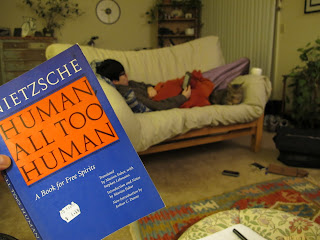
"Nietzsche was always defined through divided intentions. He did not want at any time to give up his critique of the human, all too human, as he continued all the while to build the great philosophical account of human nature that in less gifted hands would have been a treatise, an essay, an enquiry, a dissertation. He tried to practice philosophy in the way he thought of history as being practiced when in the service of life rather than in the production of academic scholars. His divided intentions very nearly queered his philosophical reputation, inasmuch as philosophers since his time have pretty largely just been academic philosophers, trained by codes of expressions Neitzsche fails to follow, whereas we might now see in him a model for how to do philosophy when we want to be taken seriously in the academy and at the same time effective in life" (xix).
And I've also been quite open about the fact that I do philosophy in a particular way because I find the true philosophical significance in its application to life, growth, and flourishing, rather than for a service within institutions. This is not an original position. In talking about Nietzsche's decision to leave the academy, Marion Faber explains, "It was not only his health, however, but also his conviction that academic life was stifling and a hindrance to a true philosopher which prompted his departure. As he had already written,...a philosopher must strive not merely to be a thinker, but primarily to be a human being; this latter goal would be better realized outside the confines of a scholarly existence" (xxii). And indeed, Nietzsche did not turn away from psychology but rather towards psychology for his explanation of things like gratitude and moral valuations. Furthermore, "We can at least speculate that such a psychology of gratitude may be partially attributed to Nietzsche's own conception of his life as struggle--with himself, his illness, and the outside world" (xxx).
So as I happily turn to the small stack of Nietzsche's books again, quite aware of the risky openness and vulnerability of my own personal feelings and the likelihood that they will be affected once more (and more!) by the pages that I read, I find a sense of comfort in the possibility that I am doing something right because I am open to and aware of this relationship between my life and philosophy. In Section 6 of Beyond Good and Evil, Nietzsche writes, "Gradually it has become clear to me what every great philosophy so far has been: namely, the personal confession of its author and a kind of involuntary and unconscious memoir; also that the moral (or immoral) intentions in every philosophy constituted the real germ of life from which the whole plant had grown. Indeed, if one would explain how the abstrusest metaphysical claims of a philosopher really came about, it is always well (and wise) to ask first: at what morality does all this (does he) aim?"
For me, I put emphasis on becoming healthier, stronger, new, and different from what I have already been, to live a life of happiness, gaiety, creativity, and vitality. All of this, is a practice in self-overcoming.
Here is the situation:
In my professional life, I'm currently reading a list of over 40 books this semester in preparation for my comprehensive exams. Fortunately for me, my tests will be on two fascinating subjects, Feminist Philosophy and 20th Century Continental Philosophy. I've tailored my lists to materials that speak directly to issues of affect, embodiment, corporeality, materiality, sexuality, neurobiology, psychology, ethics, and philosophy.
In my personal life, I've been traversing familiar yet seemingly new ground with respect to my relationships with others and with myself. My reading lists have been incredibly illuminating of my personal process to the point where I've had to quickly summarize for my therapist parts of Nietzsche's philosophy on health and vitality, ideas about the transmission of affect, notions of corporeal generosity, and Beauvoir's incredible classic, The Second Sex. I figure, she has to hear about what I am reading in order to understand from where I am coming. But more unusually, I also took time this week to explain to my advisor (the director of my committee) what sort of things I have been addressing in therapy. She knows what I am reading, but she doesn't know the extent of my involvement with these books and how they are affecting me day after day as I pass through the pages. So, in order for her to understand how I am reading Beauvoir and Nietzsche, commentary on embodiment and values, I told her about my own personal efforts in managing healthy boundaries with people, giving more of my space and my self to my partners, and working on integrating love, trust, vulnerability, and risk in my relationships with myself and others in ways that might finally help me kick this 10 month long cough.
I've spent hours over these weeks thinking about the profound and often unsettling connections that are occurring between my personal life and my philosophy. For instance, when I asked what sort of changes might occur if we follow Spinoza's and Nietzsche's idea of creating values out of a certain affective disposition (for example, joy rather than sadness), my advisor responded by saying something like,
"It's not something that we can really specifically imagine, but I do think it would change our relationships: with institutions, with others, and even with ourselves." She likened it to an example of the creation of gods. Imagine those who were so filled with gratitude, joy, and celebration that they created gods in order to have a place toward which these feelings could be directed. And compare that to a God that is created out of fear, threat, and insecurity.
This conversation occurred just a few days after I really acknowledged something important: I have high expectations. This is not news, for I have always known that I could not allow myself to be anything but responsible, mature, successful. I expect for myself to be able to take care of myself and to be independent. There are of course reasons for why I have been been made (i.e., created, sculpted) to be this way, but more importantly, it has led to a kind of inflexibility, irritability, and demanding level of expectation within myself that gets directed to those around me, and particularly toward my partners. This, too, is not news, for I have already been learning how to "lighten up" with others. In fact, it is easier to do that with others because I do it out of compassion, kindness, and love for others. But I hadn't yet paid attention to the root of the problem, which is that I could also "lighten up" on myself. Like the example of the creation of gods, imagine, I told myself, how even my closest relationships with others might be different if I could allow myself more room to be affected by others, to be less independent, to make stupid mistakes...(Of course, it would be naive at best to think that I have not already been completely affected by others, dependent on others, and made lots of silly, stupid mistakes. I get it on a cognitive level. I'm seeing what it means to internalize it on an emotional one.)
There have been numerous other experiences like this as I've been going through my philosophy, including the shocking dis-ease that occurred as I read the Second Sex and felt as though Beauvoir was narrating my life (which I have since heard is a common response), and these experiences are coupled by intense personal memories of old relationships, friendships, and family experiences. In particular, I've been appreciating the unconditional generosity of certain friends, family members, "adopted" family members, and mentors of mine over the years. As I hope to more fully grasp the fact that we are already constituted by an openness to the Other and practice that by means of concrete moments of pure generosity, I am grateful for the examples of this that I have already encountered. I have been remembering what it felt like to receive an unquestioned, unwavering, and unconditional love from one of the most influential people in my life during my most formative years...and appreciating the commitment and dedication that was expressed in that love. In a very simple sense, I am touching on what it means to love. And at the same time, I am reading carefully about Simone de Beauvoir's notion of genuine love and Merleau-Ponty's notions of intercorporeality, expressed through Rosalyn Diprose's writing on generosity: "The body at risk is a generous body, a body that is opened to the other. And this erotic generosity is creative in transforming the other's embodied situation, and hence existence, through a self-metamorphosis that...does not reduce the other to the self. Becoming flesh is a project directed toward and beyond the other, a giving without calculation that nevertheless gets something in return through the future possibilities it opens" (Corporeal Generosity, 86). More simply: "For Merleau-Ponty, this lending to and borrowing from the bodies of others is a generosity lying not just at the core of the erotic encounter but at the heart of existence itself" (89).
In spite of the often ineffable moments that reading book after book of this stuff can generate, I've had some brief conversations about my worries of being so personally involved in my work. Is there, or should there be, a strong separation between psychology and philosophy, that is, the personal work that I do in therapy and the philosophical work I do for comprehensive exams? Is there a danger in being too personally invested in the work that if others disapprove of the content or the method, I might be setting myself up for hardship when I go on the job market? Rather than writing this on a public blog for others to see, should I be pouring myself into journal publications? Is all of this stuff on relationships and personal growth just not philosophical enough for you, whoever you are?!? I've written about my struggles with these questions before. And I've recently gotten some feedback from others. My advisor said something like this (and I have always wholly agreed with this point): "If nothing else, it's good for life to approach it philosophically. And it's good for philosophy to keep it grounded in relevant issues that involve our lives." I say, what good is philosophy if it doesn't speak directly to our experiences? This semester has already been an unanticipated challenge and growing experience precisely because the books have been speaking directly to me!
And I am not alone. In fact, my favorite philosopher has stepped up to the front of the line of my next stack of books to read. Within the Introduction of Nietzsche's Human, All Too Human, Arthur Danto writes:

"Nietzsche was always defined through divided intentions. He did not want at any time to give up his critique of the human, all too human, as he continued all the while to build the great philosophical account of human nature that in less gifted hands would have been a treatise, an essay, an enquiry, a dissertation. He tried to practice philosophy in the way he thought of history as being practiced when in the service of life rather than in the production of academic scholars. His divided intentions very nearly queered his philosophical reputation, inasmuch as philosophers since his time have pretty largely just been academic philosophers, trained by codes of expressions Neitzsche fails to follow, whereas we might now see in him a model for how to do philosophy when we want to be taken seriously in the academy and at the same time effective in life" (xix).
And I've also been quite open about the fact that I do philosophy in a particular way because I find the true philosophical significance in its application to life, growth, and flourishing, rather than for a service within institutions. This is not an original position. In talking about Nietzsche's decision to leave the academy, Marion Faber explains, "It was not only his health, however, but also his conviction that academic life was stifling and a hindrance to a true philosopher which prompted his departure. As he had already written,...a philosopher must strive not merely to be a thinker, but primarily to be a human being; this latter goal would be better realized outside the confines of a scholarly existence" (xxii). And indeed, Nietzsche did not turn away from psychology but rather towards psychology for his explanation of things like gratitude and moral valuations. Furthermore, "We can at least speculate that such a psychology of gratitude may be partially attributed to Nietzsche's own conception of his life as struggle--with himself, his illness, and the outside world" (xxx).
So as I happily turn to the small stack of Nietzsche's books again, quite aware of the risky openness and vulnerability of my own personal feelings and the likelihood that they will be affected once more (and more!) by the pages that I read, I find a sense of comfort in the possibility that I am doing something right because I am open to and aware of this relationship between my life and philosophy. In Section 6 of Beyond Good and Evil, Nietzsche writes, "Gradually it has become clear to me what every great philosophy so far has been: namely, the personal confession of its author and a kind of involuntary and unconscious memoir; also that the moral (or immoral) intentions in every philosophy constituted the real germ of life from which the whole plant had grown. Indeed, if one would explain how the abstrusest metaphysical claims of a philosopher really came about, it is always well (and wise) to ask first: at what morality does all this (does he) aim?"
For me, I put emphasis on becoming healthier, stronger, new, and different from what I have already been, to live a life of happiness, gaiety, creativity, and vitality. All of this, is a practice in self-overcoming.
Tuesday, December 14, 2010
I may not be a Doctor, but...
Some people get really pissed at universities that use and abuse their graduate students and force them to teach all the mundane low-level classes to undergrads who, often with a strong sense of entitlement, don't care about class, don't try, and certainly don't appreciate you or the fact that you have your own work to be doing as you go through the motions before they get their easy "A."
As a graduate student in the third year of my program, I have already taught about 150 students of my own in four classes (not to mention the 60 or so others I TAed for in a class that even I struggled to really appreciate). But for me, I view teaching as an opportunity and I am so happy to have had experiences in the classroom that have helped my learning, thinking, and growing more than almost any class I have had as a graduate student. That I get to teach is one of the only reasons why I have made it this far in my program (and by constantly reminding myself that my life was literally changed after taking one philosophy class from one of the best professors, so I know that it is at least possible to make a difference, even if my students don't become "philosophers" themselves).
Fortunately, I have had the opportunity to put together my own syllabi for classes that I have been genuinely interested in teaching. In "Basic Problems of Philosophy" I focused the course on four questions: What is philosophy? What is the purpose of philosophy? Who is the philosopher? What is the philosopher's task? I loved the 6-week intensity of teaching "Philosophy, Love, and Sex" this summer. Seeing my students every day was very conducive to the continuity in conversations that I think is essential to deep thinking. And finally, I have just concluded my course "Philosophy, Race, and Diversity." We started with one of my favorite essays by George Yancy on philosophers as "trouble makers" and read some excellent books--Charles Mills' 'The Racial Contract,' Linda Alcoff's 'Visible Identities,' and Ladelle McWhorter's 'Racism and Sexual Oppression in Anglo-America" (go here for a recent interview about the book). This class was by far the most challenging of them all. At times, I was fearful that the class would end up a complete failure, worst of all, because my students were so often reflecting RACIST views, not anti-racist views (obviously, the latter are my preferred perspectives).
My goal in teaching is always to help my students cultivate the skills that will allow them to be more critical thinkers, not just about society and problems around them, but to understand themselves better, too. Just like any other kind of interaction, if students put their defenses up or are unwilling to be honest with themselves and others, we don't get very far (sometimes, as I have just learned, it takes a whole semester for people to put their guard down...like life, I suppose, some people don't ever get there in your time with them). Listening to others is crucial, being able to write and speak in ways that express your views is important, and the ability to be self-reflexive is completely necessary. And I don't teach material just so they will know what so-and-so said about "x." My methodology and selected content are intended to provide students with insights, perspectives, and questions that will enable them to be better students, better citizens, and better people (I am hugely influenced by hooks here). Pardon the redundancy, but I don't want to just open them up to philosophical lesson. Ideally, I hope that by being more philosophical, my students will also uncover some life lessons that will help them as they move through the world (it's philifesophy). Clearly, I have high hopes for my students and high expectations of myself!
Given the challenges of teaching, the highs and lows, the adrenaline rushes and great disappointments, the moments of insight and spells of insecurity, and the open-endedness of it all, which can often be devalued as just the cover of ineffectuality, I have to keep some record of the rewards. I don't want to let myself get carried away in worries that this is worthless work or catch a spell of the contagious skepticism that is always circulating among philosophers (and academics) about what we do.
At the end of each semester, it's always a bit scary to wait and see if any of the students "got it" (and not just if they adequately comprehended the arguments. I mean the point of this whole learning thing in general). Fortunately, after this go around, my students papers demonstrated that many of them did end up "getting it"--which is HUGE given that we had to bust through some seriously thick commitments to epistemologies of ignorance (Mills, 18). I am re-energized by the notes and emails that my students give me. Because this semester was especially challenging, I write some of the final reflections from students below:
"...I discovered a feeling that I had not had at the conclusion of other books. It's not that I had it all figured out, but I did finally see the big picture. Instead of just trying to fix racial differences overnight, McWhorter stressed that we keep challenging what is normal and abnormal, as my classmate Ray pointed out. She wants us to keep "doing likewise"...While she--and I--knows that it is not a guaranteed that we can get [to a world without racism], for now this is all that we can do. At the beginning of our class, I was one of those people that thought philosophy really was about old white men and their ridiculous ideas. Now, I am one of those "trouble makers" myself, and I am damn proud of it."
In a later email, this student also wrote,
"Cori-
I just wanted to thank you for this semester. I truly enjoyed every class that we had, and always looked forward to Tuesdays and Thursdays because of our discussions. This is a class much different than my others, not only because it was an elective, but also because I will be able to take so much from what we've talked about all semester. I really enjoyed our conversations, which led me to discover a few things about myself. I wish that all of my classes were like this one and hopefully we can meet up again in the future."
____________________________________________________________
"The semester before I had just taken Sociology 119 which had dealt with race, so I thought the course would be easy and that I would already know everything. I was very wrong. One can never know too much about racism, there's always something to talk about and learn about. This is one of the things I have recently learned. I learned many things about racism including what the word actually means, how identities are formed and interpreted, and how many people think of racism itself. Along with what I have learned about the subjects taught to me the past semester, I have learned about myself.
...
I spoke in a way that reflected my confidence of me not being racist, and that I knew everything about racism. Outside of class I talked in a way that I was not racist and in a way that I knew all about the subject matter. Whenever I had a conversation about someone being racist I put them under the bus and defended my actions. This is much like 20th Century American and what they did to Hitler. After reading Mill's (sic) book I had still not realized all the things I did and the way that I am still racist. Ironically I was a perfect example of Mill's main point; I was part of the epistemology of ignorance. It is a term that I had never heard of before reading his book, but it is a term that I will use many times after. It 's a very ingenious term which describes the 'White' person's ignorance to racism. I think the reason why at first I did not realize that I fell into his theory is because I had defined racism in a narrow way. I defined racism in a way that made me not racist.
...
I have enjoyed this class and am happy that it has allowed me to look in a mirror. It has allowed me to think in a different way, in a way that will make me a better person. Earlier I used the phrase that I was wrong with my thoughts, but I think that was a little inaccurate. (The sensitivity he demonstrates here blows me away!!-CW)I did not use those phrases to say that I am right now. That would allow me to quickly slip back into the epistemology of ignorance. I will never be right, there will always be something to learn or to adjust in my thought process. From this course forward, I will continue to learn, and I will do my best to make myself a better person especially when it comes to my ideas on racism."
____________________________________________________________________
"After learning the genealogical account of our history along with ideas fostered by you, Cori, I feel today compared to the first day of class, that there is now something that I can do to help get rid of racism and racism against the abnormal.
Overall, this class really did broaden my horizons on things that actually happened in history to what the common beliefs are about such events...I did not realize it until the end, but I thought McWhorter's book did a great joby to get us see that some of our values are flawed and that being more critical is necessary. Well, there you have it, these were many of the things I learned and that changed how I think and view society now. I was glad to have participated in a class that generated this much thinking, and really do feel my horizons have expanded from taking this class. Thanks, Cori, and hope to still see you around campus."
____________________________________________________________________
Though shout-outs of appreciation warm my heart, the truly rewarding moments are when I see my students becoming better writers and better thinkers, and especially when they start making connections on their own!
I am immensely grateful for the work of those thinkers who write amazing books who give my students and me lots to chew on. I am also grateful for what I learn from my students and what I learn from undergoing the process of thinking through big questions and important issues with them. They help me grow, and they also motivate me to keep doing what I am doing because they prove to me that teachers DO important work, regardless of whether or not this happens in a classroom.
Teaching is a skill and an art form that I hope to continue cultivating in myself. It's been my dream, my goal, and what I have wanted to do for a very long time. And I must admit, that I am quite pleased that at the ripe old age of 24, I have already had been able to do what I want to do, how I want to do it. Whatever happens after I actually get my degrees, I will be satisfied with what I have been able to accomplish as a graduate student. And I will, like some of my students, always try to keep in mind the lessons that I have learned and use them to help me be a better teacher, a better student, a better philosopher, and a better person.
As a graduate student in the third year of my program, I have already taught about 150 students of my own in four classes (not to mention the 60 or so others I TAed for in a class that even I struggled to really appreciate). But for me, I view teaching as an opportunity and I am so happy to have had experiences in the classroom that have helped my learning, thinking, and growing more than almost any class I have had as a graduate student. That I get to teach is one of the only reasons why I have made it this far in my program (and by constantly reminding myself that my life was literally changed after taking one philosophy class from one of the best professors, so I know that it is at least possible to make a difference, even if my students don't become "philosophers" themselves).
Fortunately, I have had the opportunity to put together my own syllabi for classes that I have been genuinely interested in teaching. In "Basic Problems of Philosophy" I focused the course on four questions: What is philosophy? What is the purpose of philosophy? Who is the philosopher? What is the philosopher's task? I loved the 6-week intensity of teaching "Philosophy, Love, and Sex" this summer. Seeing my students every day was very conducive to the continuity in conversations that I think is essential to deep thinking. And finally, I have just concluded my course "Philosophy, Race, and Diversity." We started with one of my favorite essays by George Yancy on philosophers as "trouble makers" and read some excellent books--Charles Mills' 'The Racial Contract,' Linda Alcoff's 'Visible Identities,' and Ladelle McWhorter's 'Racism and Sexual Oppression in Anglo-America" (go here for a recent interview about the book). This class was by far the most challenging of them all. At times, I was fearful that the class would end up a complete failure, worst of all, because my students were so often reflecting RACIST views, not anti-racist views (obviously, the latter are my preferred perspectives).
My goal in teaching is always to help my students cultivate the skills that will allow them to be more critical thinkers, not just about society and problems around them, but to understand themselves better, too. Just like any other kind of interaction, if students put their defenses up or are unwilling to be honest with themselves and others, we don't get very far (sometimes, as I have just learned, it takes a whole semester for people to put their guard down...like life, I suppose, some people don't ever get there in your time with them). Listening to others is crucial, being able to write and speak in ways that express your views is important, and the ability to be self-reflexive is completely necessary. And I don't teach material just so they will know what so-and-so said about "x." My methodology and selected content are intended to provide students with insights, perspectives, and questions that will enable them to be better students, better citizens, and better people (I am hugely influenced by hooks here). Pardon the redundancy, but I don't want to just open them up to philosophical lesson. Ideally, I hope that by being more philosophical, my students will also uncover some life lessons that will help them as they move through the world (it's philifesophy). Clearly, I have high hopes for my students and high expectations of myself!
Given the challenges of teaching, the highs and lows, the adrenaline rushes and great disappointments, the moments of insight and spells of insecurity, and the open-endedness of it all, which can often be devalued as just the cover of ineffectuality, I have to keep some record of the rewards. I don't want to let myself get carried away in worries that this is worthless work or catch a spell of the contagious skepticism that is always circulating among philosophers (and academics) about what we do.
At the end of each semester, it's always a bit scary to wait and see if any of the students "got it" (and not just if they adequately comprehended the arguments. I mean the point of this whole learning thing in general). Fortunately, after this go around, my students papers demonstrated that many of them did end up "getting it"--which is HUGE given that we had to bust through some seriously thick commitments to epistemologies of ignorance (Mills, 18). I am re-energized by the notes and emails that my students give me. Because this semester was especially challenging, I write some of the final reflections from students below:
"...I discovered a feeling that I had not had at the conclusion of other books. It's not that I had it all figured out, but I did finally see the big picture. Instead of just trying to fix racial differences overnight, McWhorter stressed that we keep challenging what is normal and abnormal, as my classmate Ray pointed out. She wants us to keep "doing likewise"...While she--and I--knows that it is not a guaranteed that we can get [to a world without racism], for now this is all that we can do. At the beginning of our class, I was one of those people that thought philosophy really was about old white men and their ridiculous ideas. Now, I am one of those "trouble makers" myself, and I am damn proud of it."
In a later email, this student also wrote,
"Cori-
I just wanted to thank you for this semester. I truly enjoyed every class that we had, and always looked forward to Tuesdays and Thursdays because of our discussions. This is a class much different than my others, not only because it was an elective, but also because I will be able to take so much from what we've talked about all semester. I really enjoyed our conversations, which led me to discover a few things about myself. I wish that all of my classes were like this one and hopefully we can meet up again in the future."
____________________________________________________________
"The semester before I had just taken Sociology 119 which had dealt with race, so I thought the course would be easy and that I would already know everything. I was very wrong. One can never know too much about racism, there's always something to talk about and learn about. This is one of the things I have recently learned. I learned many things about racism including what the word actually means, how identities are formed and interpreted, and how many people think of racism itself. Along with what I have learned about the subjects taught to me the past semester, I have learned about myself.
...
I spoke in a way that reflected my confidence of me not being racist, and that I knew everything about racism. Outside of class I talked in a way that I was not racist and in a way that I knew all about the subject matter. Whenever I had a conversation about someone being racist I put them under the bus and defended my actions. This is much like 20th Century American and what they did to Hitler. After reading Mill's (sic) book I had still not realized all the things I did and the way that I am still racist. Ironically I was a perfect example of Mill's main point; I was part of the epistemology of ignorance. It is a term that I had never heard of before reading his book, but it is a term that I will use many times after. It 's a very ingenious term which describes the 'White' person's ignorance to racism. I think the reason why at first I did not realize that I fell into his theory is because I had defined racism in a narrow way. I defined racism in a way that made me not racist.
...
I have enjoyed this class and am happy that it has allowed me to look in a mirror. It has allowed me to think in a different way, in a way that will make me a better person. Earlier I used the phrase that I was wrong with my thoughts, but I think that was a little inaccurate. (The sensitivity he demonstrates here blows me away!!-CW)I did not use those phrases to say that I am right now. That would allow me to quickly slip back into the epistemology of ignorance. I will never be right, there will always be something to learn or to adjust in my thought process. From this course forward, I will continue to learn, and I will do my best to make myself a better person especially when it comes to my ideas on racism."
____________________________________________________________________
"After learning the genealogical account of our history along with ideas fostered by you, Cori, I feel today compared to the first day of class, that there is now something that I can do to help get rid of racism and racism against the abnormal.
Overall, this class really did broaden my horizons on things that actually happened in history to what the common beliefs are about such events...I did not realize it until the end, but I thought McWhorter's book did a great joby to get us see that some of our values are flawed and that being more critical is necessary. Well, there you have it, these were many of the things I learned and that changed how I think and view society now. I was glad to have participated in a class that generated this much thinking, and really do feel my horizons have expanded from taking this class. Thanks, Cori, and hope to still see you around campus."
____________________________________________________________________
Though shout-outs of appreciation warm my heart, the truly rewarding moments are when I see my students becoming better writers and better thinkers, and especially when they start making connections on their own!
I am immensely grateful for the work of those thinkers who write amazing books who give my students and me lots to chew on. I am also grateful for what I learn from my students and what I learn from undergoing the process of thinking through big questions and important issues with them. They help me grow, and they also motivate me to keep doing what I am doing because they prove to me that teachers DO important work, regardless of whether or not this happens in a classroom.
Teaching is a skill and an art form that I hope to continue cultivating in myself. It's been my dream, my goal, and what I have wanted to do for a very long time. And I must admit, that I am quite pleased that at the ripe old age of 24, I have already had been able to do what I want to do, how I want to do it. Whatever happens after I actually get my degrees, I will be satisfied with what I have been able to accomplish as a graduate student. And I will, like some of my students, always try to keep in mind the lessons that I have learned and use them to help me be a better teacher, a better student, a better philosopher, and a better person.
Thursday, December 9, 2010
What I Learned and Why It Was Worth It.
I have three days to write a term paper on Plato. For some reason, as I sit in my room trying to write, I find myself hitting a pretty firm wall. I can't bring myself to write it. I have a good idea of what I WANT to write, but getting the words out and stringing together sentences just doesn't seem appropriate. Isn't that just writing!? This is only a hunch, but I think the strange kind of hesitation that I feel is related to what I want to write. Since the paper itself isn't happening, but I know that I need to be writing to process the ideas, I have decided to write here about my process of writing this paper.
This paper is a big one for me and not just because it's worth the entirety of my grade. Actually, I have come to care much less about my grades. Probably because this is also the last paper that I will ever have to write for a course. That's right! I am three days away from no longer being a student who has to sit in classes for requirements, do readings according to a set schedule, etc. etc. And I get why people are so excited for this moment. I am nearing the stage when I get to read and write all of my own stuff. This will be a true transition in my career, a new phase, a new experience, and a new way to do philosophy. I am starting to feel very grown up (or something) in this field.
It's also a big paper for me because it will represent the end of a very difficult semester. I've struggled through each semester of graduate school for various reasons, and this semester was ripe with stress. Taking three classes, two extra seminars, teaching one class of my own, doing an internship, taking on an assistant ship, and becoming a mentor was quite the load. Not to mention that I spent the past four months working harder then ever before to stay in my relationship, to challenge myself to approach my latent fears differently, and to grow. I always grow. So, even though I have work and meetings already planned for Tuesday and beyond, turning this paper in on Monday will feel like the end point of a big, semester-long journey.
Despite all of that "stuff," this has been a very rich semester for me. I learned a lot from teaching my class this semester on race and diversity. I learned a lot about my girlfriend and what she can help me learn about myself. And there are MANY, MANY other things that I learned that I can't quite place. In all of that learning, there were as many upsetting, disturbing, unsettling, and troublesome moments as there were inspirational, impassioned, encouraging, and "right" ones. I can't say it enough. This was quite the semester!
I know that I have grown and changed dramatically since the summer. The way I feel is different. The way I think is different. The way I speak is different. The way I listen is different. I read, I engage, I teach, and I write differently. Even my signature has changed. Over and over again. Each week it's new (isn't that significant for something?!? Dad? Don't you know something about this?).
One thing that I felt changing for me this semester was my presence in the classroom as a peer and student. I wasn't especially excited about any of my classes this semester. One in particular I absolutely abhorred. But in each class that I went to, I spoke up. I asked questions. Most of the sessions were so boring and dry anyway that I figured there was nothing to lose, only something to be gained, if I could muster the attention span to formulate a question that I was actually interested in posing to the group. And I asked a lot of questions. A LOT. And when the question that I asked started a lively conversation, I was always pretty pleased with my effort. I was also really pleased to learn something from what came out of it. I wasn't asking from a place of already knowing the answer or having my own opinion (and I decided to abandon awhile ago any idea that I know better than anyone else)-I found myself asking genuine questions because I really wanted to think about them. And I found that I really gained from hearing other people's views. Sometimes their comments were illuminating, other times confusing, and most of the time, they helped me think again. Sometimes it wasn't even what they said, but how they said it, or how they approached my question, that was the most interesting part of it.
My experience of asking real questions in all of my classes was rewarding. I was proud of myself for starting conversations. For initiating a group reflection and sustaining my own. I started to realize that I might actually have a knack for asking questions and getting others to think with me. I felt something that, in this dimension of my life, used to only happen on very rare occasions. I felt a sense of confidence.
Once I identified that this was what I was doing in my classes, I realized that my ability to ask questions has also been one of my greatest strengths in teaching. Like many people I suffer from the "imposter complex": "I'm only a grad student! I don't know enough to be influencing young minds! What if mess it up? Or get it wrong? What if they see right through my facade?!?!" So to counter this, I dropped the facade. And I started to "teach" by asking questions.
I know that I don't know what I am teaching- I am not an expert, I don't have the answers, and I don't want for my students to think that I am expecting them to regurgitate what I say. But I do know that I can present a problem to the class as it is raised in a text or lived in the "real world" and I can ask them questions that get them to think about them. My favorite days in the classroom are those when we have group presentations because I don't come with a prepared lecture or even knowing what the students will present, and I know that it is my task to identify themes, isolate problems, highlight key ideas, pause to create space for discussion, and facilitate a process that develops organically. The whole process is very unexpected and spontaneous. On those days, when connections are made through responding to what others bring to the table, I sometimes feel magical. Seriously. It's what others call "flow." I'm in it, things are moving, and stuff is happening. And I am the one directing it while my students are the ones propelling it.
This has all started to generate some new thoughts about how to proceed. New strategies are in order. Those that are different from the old ways of saying, "I'm right, now just listen to me." As I prepare myself for my first major conference presentation and talk to experts about things that I don't know anything about (law and Irigaray, for example), and as I hold on to my desire to keep making videos on youtube, I am trying to pay attention to the great value of keeping things open. Instead of reading from papers to make sure that I get all of the points right to show what a strong argument I am making, I think I will do better (whatever that means) to present the issues, offer my thoughts and the connections I have made, and raise more questions.
And what does this have to do with Plato again?
Despite my general disinterest (to put it lightly) in the things that are most frequently associated with Plato- especially all of his talk about the Forms and our souls--I have had a hunch over the years that I would need to go back to the Greeks. I mean, all of my homeboys have. Nietzsche did it. Foucault did it. Husserl said that we must do it. And at the beginning of the semester I was not thrilled to be reading Plato. I just don't get it. I don't like talking about souls as if they really exist.
As it turns out though, I really didn't get HIM.
Plato, the philosopher, the writer, the author (maybe) of so many famous dialogues between Socrates and his interlocutors, is amazing for what he did, not just for what he said (and Socrates--but their true identities are complicated). Plato/Socrates wanted to compel people to make the philosophical turn, to turn toward philosophy, to live the examined life, to critically reflect on their lives and themselves. The dialogues are often contradictory, they leave questions unresolved, and the arguments within are often quite poor in terms of logic and viability. But to focus on those things is to miss the point. Plato/Socrates engage people to think. They engage us to think. They don't leave us with answers, but rather move us in the direction of a philosophical way of life. Plato/Socrates were after the same thing that I am after.
It's what I call, philifesophy.
Who knew that Plato and Socrates would also become my homeboy(s)? And how the hell am I supposed to write a paper with an argument about Plato now without somehow attempting to ENGENDER a contradiction in action?!
Now more than ever I have an openness to not-knowing my position (and I have a deeper appreciation for what that means). I have a great sense of humility because there are so many things that I know I do not know. And I have more respect for those who help me learn how to put myself into question. My peers, my students, my philosopher-friends.
So, it seems to me, that the real reason why this semester has been so big and significant and incredible and challenging is because it has been a semester of integration. My philosophy has been informed by my life. My life has been shaped and influenced by my philosophy. It feels good. I feel open. I feel content with the groundlessness of it all and excited about the possibilities that this brings.
Now, as I turn back to my books and attempt to write this Plato paper and turn it in a for a grade in just a few days, I realize that there is a sense of gravity around bringing this semester to a close. With it's submission I will officially be moving into a new phase of my program, a new phase of my career, and I will have time to appreciate that I am in a new place in my relationship.
I am deeply grateful for this semester--It has changed me. I feel like I am a different person now. And, more than that, I think I am a better person.
This paper is a big one for me and not just because it's worth the entirety of my grade. Actually, I have come to care much less about my grades. Probably because this is also the last paper that I will ever have to write for a course. That's right! I am three days away from no longer being a student who has to sit in classes for requirements, do readings according to a set schedule, etc. etc. And I get why people are so excited for this moment. I am nearing the stage when I get to read and write all of my own stuff. This will be a true transition in my career, a new phase, a new experience, and a new way to do philosophy. I am starting to feel very grown up (or something) in this field.
It's also a big paper for me because it will represent the end of a very difficult semester. I've struggled through each semester of graduate school for various reasons, and this semester was ripe with stress. Taking three classes, two extra seminars, teaching one class of my own, doing an internship, taking on an assistant ship, and becoming a mentor was quite the load. Not to mention that I spent the past four months working harder then ever before to stay in my relationship, to challenge myself to approach my latent fears differently, and to grow. I always grow. So, even though I have work and meetings already planned for Tuesday and beyond, turning this paper in on Monday will feel like the end point of a big, semester-long journey.
Despite all of that "stuff," this has been a very rich semester for me. I learned a lot from teaching my class this semester on race and diversity. I learned a lot about my girlfriend and what she can help me learn about myself. And there are MANY, MANY other things that I learned that I can't quite place. In all of that learning, there were as many upsetting, disturbing, unsettling, and troublesome moments as there were inspirational, impassioned, encouraging, and "right" ones. I can't say it enough. This was quite the semester!
I know that I have grown and changed dramatically since the summer. The way I feel is different. The way I think is different. The way I speak is different. The way I listen is different. I read, I engage, I teach, and I write differently. Even my signature has changed. Over and over again. Each week it's new (isn't that significant for something?!? Dad? Don't you know something about this?).
One thing that I felt changing for me this semester was my presence in the classroom as a peer and student. I wasn't especially excited about any of my classes this semester. One in particular I absolutely abhorred. But in each class that I went to, I spoke up. I asked questions. Most of the sessions were so boring and dry anyway that I figured there was nothing to lose, only something to be gained, if I could muster the attention span to formulate a question that I was actually interested in posing to the group. And I asked a lot of questions. A LOT. And when the question that I asked started a lively conversation, I was always pretty pleased with my effort. I was also really pleased to learn something from what came out of it. I wasn't asking from a place of already knowing the answer or having my own opinion (and I decided to abandon awhile ago any idea that I know better than anyone else)-I found myself asking genuine questions because I really wanted to think about them. And I found that I really gained from hearing other people's views. Sometimes their comments were illuminating, other times confusing, and most of the time, they helped me think again. Sometimes it wasn't even what they said, but how they said it, or how they approached my question, that was the most interesting part of it.
My experience of asking real questions in all of my classes was rewarding. I was proud of myself for starting conversations. For initiating a group reflection and sustaining my own. I started to realize that I might actually have a knack for asking questions and getting others to think with me. I felt something that, in this dimension of my life, used to only happen on very rare occasions. I felt a sense of confidence.
Once I identified that this was what I was doing in my classes, I realized that my ability to ask questions has also been one of my greatest strengths in teaching. Like many people I suffer from the "imposter complex": "I'm only a grad student! I don't know enough to be influencing young minds! What if mess it up? Or get it wrong? What if they see right through my facade?!?!" So to counter this, I dropped the facade. And I started to "teach" by asking questions.
I know that I don't know what I am teaching- I am not an expert, I don't have the answers, and I don't want for my students to think that I am expecting them to regurgitate what I say. But I do know that I can present a problem to the class as it is raised in a text or lived in the "real world" and I can ask them questions that get them to think about them. My favorite days in the classroom are those when we have group presentations because I don't come with a prepared lecture or even knowing what the students will present, and I know that it is my task to identify themes, isolate problems, highlight key ideas, pause to create space for discussion, and facilitate a process that develops organically. The whole process is very unexpected and spontaneous. On those days, when connections are made through responding to what others bring to the table, I sometimes feel magical. Seriously. It's what others call "flow." I'm in it, things are moving, and stuff is happening. And I am the one directing it while my students are the ones propelling it.
This has all started to generate some new thoughts about how to proceed. New strategies are in order. Those that are different from the old ways of saying, "I'm right, now just listen to me." As I prepare myself for my first major conference presentation and talk to experts about things that I don't know anything about (law and Irigaray, for example), and as I hold on to my desire to keep making videos on youtube, I am trying to pay attention to the great value of keeping things open. Instead of reading from papers to make sure that I get all of the points right to show what a strong argument I am making, I think I will do better (whatever that means) to present the issues, offer my thoughts and the connections I have made, and raise more questions.
And what does this have to do with Plato again?
Despite my general disinterest (to put it lightly) in the things that are most frequently associated with Plato- especially all of his talk about the Forms and our souls--I have had a hunch over the years that I would need to go back to the Greeks. I mean, all of my homeboys have. Nietzsche did it. Foucault did it. Husserl said that we must do it. And at the beginning of the semester I was not thrilled to be reading Plato. I just don't get it. I don't like talking about souls as if they really exist.
As it turns out though, I really didn't get HIM.
Plato, the philosopher, the writer, the author (maybe) of so many famous dialogues between Socrates and his interlocutors, is amazing for what he did, not just for what he said (and Socrates--but their true identities are complicated). Plato/Socrates wanted to compel people to make the philosophical turn, to turn toward philosophy, to live the examined life, to critically reflect on their lives and themselves. The dialogues are often contradictory, they leave questions unresolved, and the arguments within are often quite poor in terms of logic and viability. But to focus on those things is to miss the point. Plato/Socrates engage people to think. They engage us to think. They don't leave us with answers, but rather move us in the direction of a philosophical way of life. Plato/Socrates were after the same thing that I am after.
It's what I call, philifesophy.
Who knew that Plato and Socrates would also become my homeboy(s)? And how the hell am I supposed to write a paper with an argument about Plato now without somehow attempting to ENGENDER a contradiction in action?!
Now more than ever I have an openness to not-knowing my position (and I have a deeper appreciation for what that means). I have a great sense of humility because there are so many things that I know I do not know. And I have more respect for those who help me learn how to put myself into question. My peers, my students, my philosopher-friends.
So, it seems to me, that the real reason why this semester has been so big and significant and incredible and challenging is because it has been a semester of integration. My philosophy has been informed by my life. My life has been shaped and influenced by my philosophy. It feels good. I feel open. I feel content with the groundlessness of it all and excited about the possibilities that this brings.
Now, as I turn back to my books and attempt to write this Plato paper and turn it in a for a grade in just a few days, I realize that there is a sense of gravity around bringing this semester to a close. With it's submission I will officially be moving into a new phase of my program, a new phase of my career, and I will have time to appreciate that I am in a new place in my relationship.
I am deeply grateful for this semester--It has changed me. I feel like I am a different person now. And, more than that, I think I am a better person.
Tuesday, September 14, 2010
Thinking Contingently
During my first semester as a grad student I was plagued with thoughts of not doing enough. Not reading enough. Not writing enough. And certainly not knowing enough. Since the doubts, insecurities, and general feelings of "not yet enough" have persisted, I figure it is a worthy experience to address. In fact, it was only recently that I fully embraced the reality that, with respect to philosophy (and perhaps many other things...), the "not yet" will be one of the only constants. As long as I continue to be a subject who undergoes changes, discoveries, transformations, I will never reach an end. As long as I am breathing, there will always be more-- more to learn, more to read, and more to know. What I am realizing is that the "enough" often does not have to follow the "not yet." Freeing myself from this connection has been important for my own sanity as a graduate student because, as far as knowing stuff goes, I have now opened myself up to the likelihood of fallibility and incompleteness. I don't have to know everything right now. But in terms of philosophy and the nature of thinking, it also just seems to make sense to reconsider what "not yet enough" even means since one cannot really know everything. Ever.
There have been certain scholars who think of truth as an event. To say that truth is an event is to suggest that it is not a given, and it is not absolute, eternal, or unchanging. What counts as truth is subject to various shifting factors such as new insights, inventions, and technological advancements, not to mention cultural, political, social, religious, or personal interests. One may not really "discover" a truth, but rather create or construct one. Truth occurs at the intersection of various forces and influences.
People can argue for ages on the nature of truth, and they have, but here I want to explore what it means for knowledge to be an event. What one knows is more obviously influenced by particular factors such as timing and location. Knowledge cannot be absolute, and so long as one is learning, knowledge is certainly not unchanging. We are accustomed to thinking of one's knowledge as growing, but knowledge can also fade. You can increase your knowledge of something by studying it extensively, but if you don't use what you know, you can lose it. Plato noted this much in the Symposium when Diotima explains that "not only does one branch of knowledge come to be in us while another passes away and that we are never the same even in respect of our knowledge, but that each single piece of knowledge has the same fate. For what we call studying exists because knowledge is leaving us, because forgetting is the departure of knowledge, while studying puts back a fresh memory in place of what went away, thereby preserving a piece of knowledge, so that it seems to be the same" (208a-b). Sure our knowledge comes and goes and is subject to change, but from the angsty perspective of a grad student who sometimes succumbs to the feeling of needing to know everything, or at least way more, in order to amount to anything, I am going to need more reasons for my faulty knowledge than just time and old age. Especially since I'm still a long way off from old age.
Let me tell you some of the reasons why I can't know everything, and I will restrict my comments to the discipline of philosophy. I speak, read, and write in English, which limits what I can read and which thinkers will be able to directly affect me. Thankfully, there are translations of texts, so I can read most of Nietzsche's work, but there are still untranslated texts of Foucault, for example, who is crucial to my thought. I have worked on learning French and that helps, but I do not have easy access, especially if it is unaided by another's translation, to the work of my roommate's favorite Turkish philosopher, or to work done in Chinese, or any African philosophy. In fact, I think many people fail to fully appreciate that people outside of the Western European frame have been doing philosophy for a long time, that people outside of it are currently doing philosophy, and that many of the same questions are being asked, or already have been asked, and there might be other incredible ideas being born. The parameters of the field of philosophy are often thought to be global in scope, but they are often extremely provincial in resources and content. Hence, language and translation are major limits to what one can know.
Time also limits my capacity to know as does the sheer physical impossibility of reading everything. Even if I was literate in all the languages in the world, I simply wouldn't be able to read all of the thoughts that have been recorded by people. There just wouldn't be enough time in one's life to do so. But even if I could read it all while still managing to eat, sleep, and do all the other necessary things to sustain my bookworm lifestyle, I probably wouldn't retain all of what I read. These are obvious points, but they are important in that they highlight a couple of issues. For one, if all one ever did was read in order to "know" more, this wouldn't leave any time for writing anything of one's own. Since writing is a significant piece of philosophy, an arbitrary but necessary line has to be drawn somewhere. There are times when the books have to be put down.
However, this may create some anxiety for those who wish to write and spawn a bit of an existential crisis. Because the other side of this coin shows that there will be some texts that *won't* be read. They may be historical texts written long ago that no one knows about anymore, or they could be texts written last year that are just bypassed because they are the superfluous layers that one just can't get in to, for whatever reason. Not because they are bad or not worth reading, but because there are limitations to the volume that we can literally read. If one, like me, wishes to write and contribute to the recorded history of ideas, this points to the possibility that your own work won't be read. At some point, then, one might be led to cynicism and say, "Why bother reading if I'm just going to forget it, and why bother writing if it's not going to be read?"
Fortunately, the pitiful image of the potential meaninglessness of reading and writing does not provide the whole story. Even though at times it can seem easier to throw my hands up and exclaim, "It's not worth it!" I have to first check in and see what I am really trying to accomplish in reading and writing philosophy.
There is a clear connection between reading philosophical works that have been written by others (despite the limitations on what actually can be read) and writing one's own philosophical material. Of course, one can read and only read without touching a keyboard, or one can write down isolated ruminations without reading anything else. But for me, I have to read in order to write well. I have to know what has been said by others in order to spur my own thoughts. The two are related to one another. Remember, the question that leads to spells of anxiety asks, "How can I ever writing anything meaningful or worth reading if I don't know enough about anything yet?!"
Here's the good news: I don't want to know everything. Not only is it impossible, but as I have been saying, I don't need to know everything. It is probably better off to think something before you write, but you don't need to know everything in order to think. And instead of aiming to know anything for sure, I am seeing more and more that there is real value in dedicating oneself to the practice of thinking itself.
Descartes asserted his existence in light of his thinking ("I think, therefore, I am!"), but something that we don't often acknowledge is who, or what, is the "I" that thinks. I am a changing, temporal subject. I have a past filled with experiences, books, lectures, memories, and singular events. I have a present that is filled with much of the same, which in turn, will become part of my past. And I have an open future that will present me with more experiences, books, lectures, conversations, relationships, etc. As I change and grow so, too, do the influences on my thinking.
With that said, there is another crucial point to make: Reading books is not the only way to acquire knowledge. It would be a sad day for me if rich philosophical material boiled down to what has been written in books. What about life? What about relationships? What about all the little things that make up our existence? Aren't those rich resources for philosophical thought, too?
Our thinking is influenced by our experiences and what we are exposed to--books and otherwise. I recently read a very good article by Rosalyn Diprose called, "What is (Feminist) Philosophy?" where she argues that thinking, rather than being an individual's exercise of autonomous reason is actually, and primarily, grounded in an affective response to an other. Something--an idea, a statement, a person--gives us reason to pause. They effect us, and our affect of disturbance, inspiration, disgust, outrage, or concordance is a response to what the other provides.
In one way, this is as simple as saying that different things will catch my attention at different times. Or put another way, my own state of being or state of mind will affect what I think about. To shamelessly use myself as an example, it was during one particularly lonely semester when I was reading Nietzsche and saw that Nietzsche's work can be read as a call for friendship. As I read, it was one of the only ways for me to approach the text so I wrote my semester paper on how he and I were friends...or, lovers... But you get my point. Now when I read Nietzsche, I am especially attuned to what he says about physiology, bodies, and health. Perhaps it is because I have been sick for 13 weeks now, but the idea is that what I think about changes because I as a subject am changing, and that is partially because what occurs around me is changing.
This means that what we think is a purely contingent matter. Nothing is necessary in the sense that there is a logical, purely rational, or required development of one's thought that one has to undergo. One does not need to read Plato, then Descartes, then Kant, then Hegel, then Derrida. One certainly does not need to read them with a particular interpretation of the text either. How one reads a text can change from day to day, year to year. And that is wonderful, because new ideas can be generated by contact with the same source.
If one does follow a particular pattern, for instance, a historical canon of certain thinkers, this will often affect the way that one thinks. At one point, appreciating this provided me with a bit of relief. If I said, "I want to be the next Judith Butler!" I would be setting myself up for failure. I can't be the next Judy B. because, obviously, if anything I am saying is insightful at all, I would not have the same experiences that she has had that would cause her to read Levinas in the way that she did. Furthermore, she was trained as a Hegelian and I am so far from a Hegel scholar that some might wonder how I could even consider myself a philosopher . But, instead of running for a copy of Hegel's Phenomenology of Spirit, I have to remember that I don't need to be Judy B. to be a philosopher. I can be ME, a unique subject, particular in her experiences and influences, who can think something original out of this uniqueness.
So what about contingency?
What one thinks, or as others more often say, what one knows is a completely contingent thing. It is contingent on what one has read, what has been said by others, what one picks up, what one wants to respond to, what one finds important or interesting, what one wishes to accomplish. To think, to know, is to be affected by the intersection, interplay, and influence of various different factors. Some influential factors are personal--psychological, individual, relational--some are philosophical--I have read way more feminist philosophy than German idealism--and some are historical, geographical, and social--I am not arguing for God's existence, but instead addressing the political stakes of gender identification.
The reason why the event of my thinking is contingent, then, is because it could have gone in so many other ways. But all of the factors that came together at this moment, or this month, or in little ol' me in this lifetime, are those that resulted in the cognitive, affective, creative response that that is thinking.
In short, I don't need to know everything in order to be a worthy grad-student-wanna-be-pro-philosopher. I might even be able to give up on the idea that my philosophical knowledge is "not yet enough" because there might not be the requirement that one has to "know" anything at all. The important thing, at least it seems to me, is to be able to think. And if I can think, then I can write. And even if what I write isn't read by all people for all time, that is just fine, so long as what I write can encourage myself and others to think again.
If there is one thing that I can agree on with Descartes, it is that I am a thinking thing. And as it stands now, that is enough for me.
There have been certain scholars who think of truth as an event. To say that truth is an event is to suggest that it is not a given, and it is not absolute, eternal, or unchanging. What counts as truth is subject to various shifting factors such as new insights, inventions, and technological advancements, not to mention cultural, political, social, religious, or personal interests. One may not really "discover" a truth, but rather create or construct one. Truth occurs at the intersection of various forces and influences.
People can argue for ages on the nature of truth, and they have, but here I want to explore what it means for knowledge to be an event. What one knows is more obviously influenced by particular factors such as timing and location. Knowledge cannot be absolute, and so long as one is learning, knowledge is certainly not unchanging. We are accustomed to thinking of one's knowledge as growing, but knowledge can also fade. You can increase your knowledge of something by studying it extensively, but if you don't use what you know, you can lose it. Plato noted this much in the Symposium when Diotima explains that "not only does one branch of knowledge come to be in us while another passes away and that we are never the same even in respect of our knowledge, but that each single piece of knowledge has the same fate. For what we call studying exists because knowledge is leaving us, because forgetting is the departure of knowledge, while studying puts back a fresh memory in place of what went away, thereby preserving a piece of knowledge, so that it seems to be the same" (208a-b). Sure our knowledge comes and goes and is subject to change, but from the angsty perspective of a grad student who sometimes succumbs to the feeling of needing to know everything, or at least way more, in order to amount to anything, I am going to need more reasons for my faulty knowledge than just time and old age. Especially since I'm still a long way off from old age.
Let me tell you some of the reasons why I can't know everything, and I will restrict my comments to the discipline of philosophy. I speak, read, and write in English, which limits what I can read and which thinkers will be able to directly affect me. Thankfully, there are translations of texts, so I can read most of Nietzsche's work, but there are still untranslated texts of Foucault, for example, who is crucial to my thought. I have worked on learning French and that helps, but I do not have easy access, especially if it is unaided by another's translation, to the work of my roommate's favorite Turkish philosopher, or to work done in Chinese, or any African philosophy. In fact, I think many people fail to fully appreciate that people outside of the Western European frame have been doing philosophy for a long time, that people outside of it are currently doing philosophy, and that many of the same questions are being asked, or already have been asked, and there might be other incredible ideas being born. The parameters of the field of philosophy are often thought to be global in scope, but they are often extremely provincial in resources and content. Hence, language and translation are major limits to what one can know.
Time also limits my capacity to know as does the sheer physical impossibility of reading everything. Even if I was literate in all the languages in the world, I simply wouldn't be able to read all of the thoughts that have been recorded by people. There just wouldn't be enough time in one's life to do so. But even if I could read it all while still managing to eat, sleep, and do all the other necessary things to sustain my bookworm lifestyle, I probably wouldn't retain all of what I read. These are obvious points, but they are important in that they highlight a couple of issues. For one, if all one ever did was read in order to "know" more, this wouldn't leave any time for writing anything of one's own. Since writing is a significant piece of philosophy, an arbitrary but necessary line has to be drawn somewhere. There are times when the books have to be put down.
However, this may create some anxiety for those who wish to write and spawn a bit of an existential crisis. Because the other side of this coin shows that there will be some texts that *won't* be read. They may be historical texts written long ago that no one knows about anymore, or they could be texts written last year that are just bypassed because they are the superfluous layers that one just can't get in to, for whatever reason. Not because they are bad or not worth reading, but because there are limitations to the volume that we can literally read. If one, like me, wishes to write and contribute to the recorded history of ideas, this points to the possibility that your own work won't be read. At some point, then, one might be led to cynicism and say, "Why bother reading if I'm just going to forget it, and why bother writing if it's not going to be read?"
Fortunately, the pitiful image of the potential meaninglessness of reading and writing does not provide the whole story. Even though at times it can seem easier to throw my hands up and exclaim, "It's not worth it!" I have to first check in and see what I am really trying to accomplish in reading and writing philosophy.
There is a clear connection between reading philosophical works that have been written by others (despite the limitations on what actually can be read) and writing one's own philosophical material. Of course, one can read and only read without touching a keyboard, or one can write down isolated ruminations without reading anything else. But for me, I have to read in order to write well. I have to know what has been said by others in order to spur my own thoughts. The two are related to one another. Remember, the question that leads to spells of anxiety asks, "How can I ever writing anything meaningful or worth reading if I don't know enough about anything yet?!"
Here's the good news: I don't want to know everything. Not only is it impossible, but as I have been saying, I don't need to know everything. It is probably better off to think something before you write, but you don't need to know everything in order to think. And instead of aiming to know anything for sure, I am seeing more and more that there is real value in dedicating oneself to the practice of thinking itself.
Descartes asserted his existence in light of his thinking ("I think, therefore, I am!"), but something that we don't often acknowledge is who, or what, is the "I" that thinks. I am a changing, temporal subject. I have a past filled with experiences, books, lectures, memories, and singular events. I have a present that is filled with much of the same, which in turn, will become part of my past. And I have an open future that will present me with more experiences, books, lectures, conversations, relationships, etc. As I change and grow so, too, do the influences on my thinking.
With that said, there is another crucial point to make: Reading books is not the only way to acquire knowledge. It would be a sad day for me if rich philosophical material boiled down to what has been written in books. What about life? What about relationships? What about all the little things that make up our existence? Aren't those rich resources for philosophical thought, too?
Our thinking is influenced by our experiences and what we are exposed to--books and otherwise. I recently read a very good article by Rosalyn Diprose called, "What is (Feminist) Philosophy?" where she argues that thinking, rather than being an individual's exercise of autonomous reason is actually, and primarily, grounded in an affective response to an other. Something--an idea, a statement, a person--gives us reason to pause. They effect us, and our affect of disturbance, inspiration, disgust, outrage, or concordance is a response to what the other provides.
In one way, this is as simple as saying that different things will catch my attention at different times. Or put another way, my own state of being or state of mind will affect what I think about. To shamelessly use myself as an example, it was during one particularly lonely semester when I was reading Nietzsche and saw that Nietzsche's work can be read as a call for friendship. As I read, it was one of the only ways for me to approach the text so I wrote my semester paper on how he and I were friends...or, lovers... But you get my point. Now when I read Nietzsche, I am especially attuned to what he says about physiology, bodies, and health. Perhaps it is because I have been sick for 13 weeks now, but the idea is that what I think about changes because I as a subject am changing, and that is partially because what occurs around me is changing.
This means that what we think is a purely contingent matter. Nothing is necessary in the sense that there is a logical, purely rational, or required development of one's thought that one has to undergo. One does not need to read Plato, then Descartes, then Kant, then Hegel, then Derrida. One certainly does not need to read them with a particular interpretation of the text either. How one reads a text can change from day to day, year to year. And that is wonderful, because new ideas can be generated by contact with the same source.
If one does follow a particular pattern, for instance, a historical canon of certain thinkers, this will often affect the way that one thinks. At one point, appreciating this provided me with a bit of relief. If I said, "I want to be the next Judith Butler!" I would be setting myself up for failure. I can't be the next Judy B. because, obviously, if anything I am saying is insightful at all, I would not have the same experiences that she has had that would cause her to read Levinas in the way that she did. Furthermore, she was trained as a Hegelian and I am so far from a Hegel scholar that some might wonder how I could even consider myself a philosopher . But, instead of running for a copy of Hegel's Phenomenology of Spirit, I have to remember that I don't need to be Judy B. to be a philosopher. I can be ME, a unique subject, particular in her experiences and influences, who can think something original out of this uniqueness.
So what about contingency?
What one thinks, or as others more often say, what one knows is a completely contingent thing. It is contingent on what one has read, what has been said by others, what one picks up, what one wants to respond to, what one finds important or interesting, what one wishes to accomplish. To think, to know, is to be affected by the intersection, interplay, and influence of various different factors. Some influential factors are personal--psychological, individual, relational--some are philosophical--I have read way more feminist philosophy than German idealism--and some are historical, geographical, and social--I am not arguing for God's existence, but instead addressing the political stakes of gender identification.
The reason why the event of my thinking is contingent, then, is because it could have gone in so many other ways. But all of the factors that came together at this moment, or this month, or in little ol' me in this lifetime, are those that resulted in the cognitive, affective, creative response that that is thinking.
In short, I don't need to know everything in order to be a worthy grad-student-wanna-be-pro-philosopher. I might even be able to give up on the idea that my philosophical knowledge is "not yet enough" because there might not be the requirement that one has to "know" anything at all. The important thing, at least it seems to me, is to be able to think. And if I can think, then I can write. And even if what I write isn't read by all people for all time, that is just fine, so long as what I write can encourage myself and others to think again.
If there is one thing that I can agree on with Descartes, it is that I am a thinking thing. And as it stands now, that is enough for me.
Subscribe to:
Posts (Atom)